In this unique era of human history, manned space flight -- the dream of many a novelist -- has become routine. Star Trek and its spin-offs have taken our imaginations far beyond our giant leap to the moon. Is the sky the limit?
Most manned space flight has been in the relatively safe zone of low earth orbit. The president's "Moon, Mars and Beyond" initiative, however, is forcing physiologists to consider the hazards of prolonged exposure to space. The news is not good. Earthlings, count your blessings.
Outer space is no calm vacuum. It is filled with fast-moving particles, from the smallest neutrinos to massive meteoroids. The solar wind blows electrons and protons at over a million mph. Without warning, solar flares can erupt, emitting 100 times the sun's normal X-ray energy output. In addition, high-energy cosmic rays from deep space can easily penetrate a spaceship and a human body, causing cumulative damage to tissues and DNA.
Shuttle and space station astronauts operate within Earth's protective Van Allen belts and gravitational field. So far, only the Apollo astronauts have ventured outside our safe bubble into the cosmic shooting gallery. The longest mission, Apollo 17, lasted only 12 days. Fortunately, none of the flights occurred during a solar flare. Had the space travelers received such a blast, they would have been dead within minutes.
This is just one of many risks that future Mars astronauts would face on a three-year mission. Last September, NASA medical researchers described "Risk 29": the cumulative damage from cosmic rays. A press release warned, "massive amounts of solar and cosmic radiation will decimate the brains of astronauts, leaving them in a vegetative state, if they survive at all." The sight of a demented crew emerging from their craft is hardly the photo-op to boost national pride.
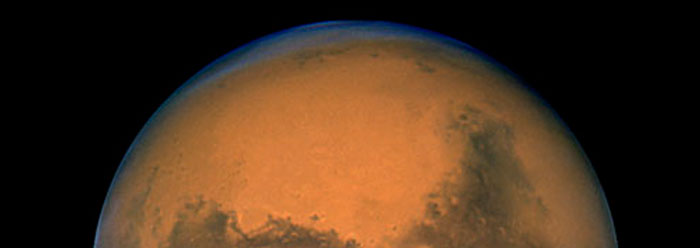
Unlike Earth, Mars has no global magnetic field. The night side could offer shielding from the sun, but astronauts would have to live underground to avoid cosmic rays. But in some ways, solid shielding is worse than none at all. High-energy particles impacting a barrier generate showers of secondary particles, causing even more damage. The best shields are not practical: walls two feet thick filled with hydrogen.
Even if these show-stoppers are overcome, Mars is no place for playful romps. Dust devils meandering over the ultra-dry surface generate highly oxidizing compounds, blanketing the soil with toxic chemicals and charging the dust with static electricity. Fine dust would get into everything, irritating moist membranes and damaging equipment (see Astronomy, March 2006). Mars probably smells awful, too, and the atmosphere is so thin, nobody could hear you scream.
We wish the best to future Mars astronauts. Humans are creative problem-solvers, and with some luck (avoiding solar flares and meteoroids on the trip), one day we may welcome home the first Mars astronauts with a ticker-tape parade on Broadway. In the meantime, step outside underneath the gentle sun, breathe the sweet air, and thank God.
*David F. Coppedge works in the Cassini program at the Jet Propulsion Laboratory.
Cite this article: Coppedge, D. 2007. Space Travel? Shields UP! Acts & Facts. 36 (3).