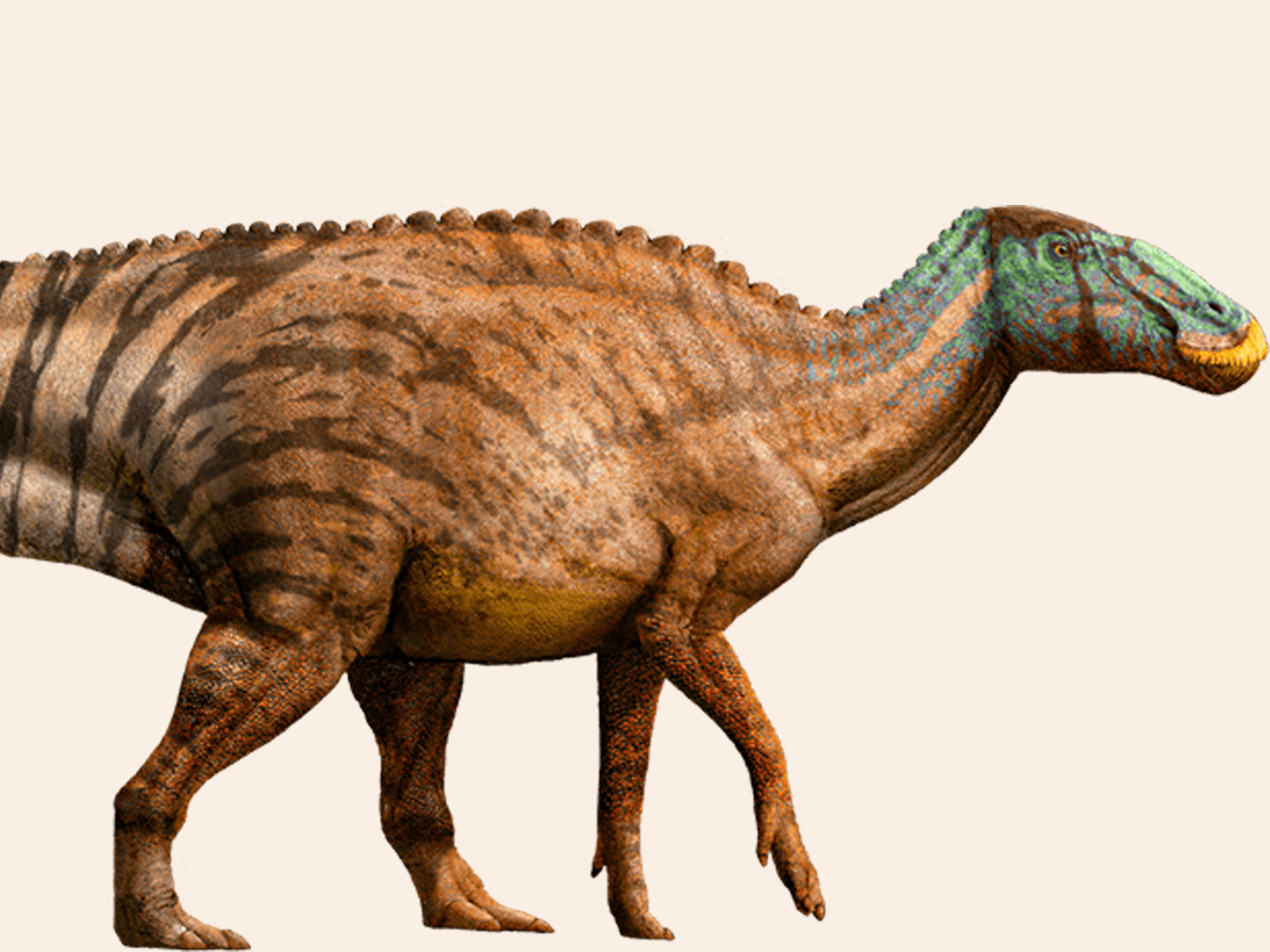
Eight species of dinosaurs were recently unearthed in the Prince Creek Formation of northern Alaska.1 The latest discovery, published in Current Biology, claims the bones were near the North Pole at the time of their burial in Cretaceous System rocks (about 80-85 degrees north latitude).1 This would give the region about 120 days of total darkness each year, making it difficult for dinosaurs to survive in such an extreme cold climate.1 Evolutionary theory provides no explanation for why dinosaurs would be buried in such environments—but Bible-based Flood geology does.
For 70 years now, dinosaurs found in supposedly polar climates have baffled secular paleontologists due to the cold conditions they would have faced and the long periods of darkness involved. Previously, dinosaur fossils and their egg shells were found in northeastern Russia, at a paleolatitude2 (which means their supposed latitude at the time of burial, before the shifting of tectonic plates) of about 70-75 degrees north of the equator. This latitude would have given about 45 days of total darkness per year.3
Last year, evolutionary scientists announced the discovery of dinosaurs in southeastern Australia that they claimed were deposited at a paleolatitude of 76 degrees south of the equator.4 Lead author Patrick Druckenmiller, from the University of Alaska Museum of the North told New Scientist: “We knew dinosaurs had been there, but we didn’t know if they could deal with the cold or even the darkness of winter.”5
In the past, most evolutionary paleontologists assumed that dinosaurs migrated to extreme high latitudes during the long summers and migrated away in the winter months. But the most recent discovery included many eggs, hatchlings, and juveniles in the cache of bones, indicating that these dinosaurs couldn’t have migrated.1
“There’s good evidence that these dinosaurs had incubation periods of over five months,” said Druckenmiller.5 This means that if the dinosaurs laid eggs in the spring, they wouldn’t have hatched until fall. These new hatchlings would have been too small to migrate the great distances necessary to escape the cold and darkness of winter. This implies the dinosaurs were year-round residents of these locations.
So, what gives? How could dinosaurs live so far north and south of the equator and at such high latitudes where the mean annual temperatures were about 50 degrees Fahrenheit or less? Secular science offers no adequate solution to this dilemma.
But ICR scientists have a better explanation, and one that is based on rock data. Our Column Project team has mapped out the megasequences and sedimentary rocks across multiple continents.6 We used these data to reconstruct the pre-Flood land masses and their environments. It resulted in a pre-Flood world that resembled Pangaea and was centered at the equator.6 In fact, nearly all of the land was at latitudes of less than 45 degrees north or south of the equator.
Our reconstruction places the newly discovered dinosaurs in Alaska at about 35-40 degrees north latitude in the pre-Flood world—not at 80-85 degrees where the researchers placed them.6 This provides a much more moderate climate where dinosaurs could thrive. These dinosaurs didn’t live in the far north, nor was Alaska this far north in the original Creation. It wasn’t until rapid plate motion during the Flood that these buried dinosaurs were moved to their present location in Alaska of about 70 degrees north latitude. They were never at 80-85 degrees north.
ICR’s plate reconstructions also place the other discoveries of high latitude Russian and Australian dinosaurs at similarly moderate latitudes in our pre-Flood world.4,6 Explanations of extremely high paleolatitude survival is only an evolutionary fairy tale.
Jesus had a perfect plan for His creation. Dinosaurs were placed in warm and moderate climates. It wasn’t until the wickedness of mankind brought on the judgment of a global flood that these dinosaurs were inundated and their bones moved far from their original locations. The Bible provides the answers.
References
1. Druckenmiller, P.S., et al. 2021. Nesting at extreme polar latitudes by non-avian dinosaurs. Current Biology. 31. DOI: https:// doi.org/10.1016/j.cub.2021.05.041
2. Paleolatitude refers to the supposed past location of the rock layer during its deposition and also where the animals found as fossils were assumed to have lived. Secular science places northern Alaska at extreme high latitudes in the Cretaceous. Contrary to these evolutionary reconstructions, the pre-Flood location is the actual location where the animals resided prior to their inundation. Our reconstructions place these dinosaurs at much more modest latitudes. Later plate movement during the Flood moved Alaska to its present location.
3. Godefroit, P., et al. 2009. The last polar dinosaurs: high diversity of latest Cretaceous arctic dinosaurs in Russia. Naturwissenschaften. 96:495–501. https://doi.org/10.1007/s00114-008-0499-
0.
4. Clarey, T. 2020. New Australian dinosaur surprises evolutionists. Creation Science Update. Posted on ICR.org May 27, 2020, accessed July 29, 2021.
5. Duke, C. 2021. Dinosaurs lived in the Arctic around 70 million years ago. New Scientist. 3341, published July 3, 2021, accessed July 29, 2021.
6. Clarey, T. 2020. Carved in Stone: Geological Evidence of the Worldwide Flood. Institute for Creation Research, Dallas, TX, pp. 178-179.
*Dr. Clarey is Research Scientist at the Institute for Creation Research and earned his doctorate in geology from Western Michigan University.
North Pole Dinosaurs Point to the Flood
More Fossils Show Rapid and Catastrophic Burial
Dino Footprints Down Under
Dinosaur trackways1 are once again making the news. Australia is the setting of a remarkable series of dinosaur tracks attributed to ornithischian...
ICR Scientist Publishes Dino Protein in Mainstream Journal
Conventional thinking relegates creationists—folks who believe that God created the world only thousands of years ago—to quack science....
Flood Buried Dinosaurs with a Bang
Scientists from the University of Bath have found that dinosaurs were thriving up to the end of the Cretaceous.1 This discovery conflicts with...
More Men and Dinosaurs Coexisted
Even Sherlock Holmes Can’t Explain African Dinosaurs
A new species of duck-billed dinosaur, Ajnabia odysseus, was recently unearthed in North Africa.1 This is the first hadrosaur-type dinosaur...
Scientists Late to Recognize Human and Giant Mammal Coe.,.
Giant mammals roamed North America during the Ice Age, but were humans among them? A site in Vero Beach on Florida's East coast contains mammoth,...
We Still Can’t Determine the Sex of Dinosaurs
Recently, a new study led by Queen Mary University of London concluded that dinosaur bones tell us little about their sexes.1 In the past, secular...
More Creation Science Update
The Lord Jesus: The Gift of Christmas
“Therefore God also has highly exalted Him and given Him the name which is above every name, that at the name of Jesus every knee should bow,...
Microraptor Ate Mammals But Was Not a Dinosaur
The recent claim of a nearly half-inch mammal foot in the stomach of a ‘dinosaur’ is tainted by evolutionary dogma.1 The fossil...
Thalattosuchians…Extinct Crocodile Relatives?
The Thalattosuchia are an extinct group of marine crocodylomorphs (a group that includes the crocodiles) that allegedly transitioned from land to water...
The Latest

September Wallpaper
"[Cast] all your care upon Him, for He cares for you." (1 Peter 5:7, NKJV)
ICR's September 2026 wallpaper is now...
Life’s Origins: The Bootstrap Problem
Could life’s instructions exist without ever being made? This question raises what is called a “bootstrap problem.”1 It...
The Power of a Meek Life
One of the clearest voices calling believers to surrender to Jesus was George Whitefield, who said, “I have just put my soul as a blank into the...

Extent of the Curse and the Hope of Redemption
“For we know that the whole creation groaneth and travaileth in pain together until now.” Romans 8:22*
At the end of the sixth day of...
Modern Idolatry: Crediting Natural Selection as the Creator
“Have no other gods before Me.” Exodus 20:3
In the beginning God created the heavens and the earth” (Genesis 1:1). The Creator...
Is Death a Curse or Life’s Change Agent?
“The last enemy that will be destroyed is death.” 1 Corinthians 15:26
Without a doubt, there is a sting to death that is felt by Christians...
A Literal First Adam and Redemption in Christ
“ . . . the son of Enosh, the son of Seth, the son of Adam, the son of God.” Luke 3:38
Was there a literal Adam created along with his...
How Can Anyone Believe There Was a Global Flood?
“Whereby the world that then was, being overflowed with water, perished.” 2 Peter 3:6*
I am often asked, “Where is the evidence...
Creation in Six Days: Both Biblical and Practical
“For in six days the LORD [Yahweh] made the heavens and the earth.” Exodus 20:11
We are clearly told in Genesis 1 that God created the...

General Revelation: Power and Wisdom in God’s Creation
“Thou madest him to have dominion over the works of thy hands; thou hast put all things under his feet.” Psalm 8:6*
God is the great...
Shop Related Products
Carved in Stone
$39.99