One of the many beautifully designed bio-mechanical systems in the living world is the countercurrent exchanger. This mechanism is a "wonderful net" that involves the movement of fluid in opposite directions through vessels positioned side-by-side. In an article, evolutionist P. F. Scholander spoke of this exchanger as "... a truly remarkable piece of biological engineering."1 There are numerous examples of countercurrent exchange in aquatic creatures.
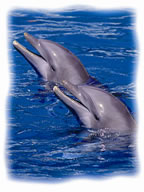
The flukes and fins of marine mammals, such as dolphins and whales, have been designed with countercurrent heat exchangers so these thin structures do not freeze in icy waters. Whales have thick insulating layers of blubber that effectively offers protection, but the massive mouth could be a potential source of significant heat loss because it cannot be lined with blubber. Since its mouth is constantly awash with frigid water as the whale feeds, the Creator placed countercurrent exchangers in the massive tongue of some baleen whales such as the grey whale.
These exchangers in the tongue contain a network of small veins surrounding larger and warmer arterial vessels coming from the body core. The veins contain cooler, venous blood going toward the heart by way of the jugular vein. Dozens of these heat exchangers allow the shift of heat from warm blood coming from the body's interior to the adjacent venous blood returning from the extremities. As a result of this exchange, only a small amount of the animal's heat is lost to the cold waters (see Science 278:1138-1139).
Conversely, right whales must rid themselves of dangerous excess heat as they undergo physical activities in warmer waters. Once again, countercurrent exchangers are used. They are in the upper jaw in the form of a device (the basalcranial rete) that radiates body heat into the water before such heat could damage delicate brain tissue.
Fish gills also have countercurrent exchangers designed to ensure the most efficient extraction of oxygen from the surrounding water. Water flows across capillary beds in the gills that are just a cell thick. The capillaries contain main afferent ("toward the center") and efferent ("leading away") blood vessels. This flow of blood in the fish runs counter to the water surging through the gills, resulting in a much greater saturation of the fish's blood with oxygen — extracting about 80 per cent of the oxygen from the water! The efferent artery then carries oxygenated blood throughout the animal.
Scholander concludes his article by saying, "We cannot fail to be impressed by the marvels of bio-engineering that nature has achieved in its development of 'the wonderful net'."2 The creationist gives no credit to "nature" — but to "the living God, which made heaven, and earth, and the sea, and all things that are therein" (Acts 14:15).
_____________________________
1. Scholander, P. F., Vertebrate Structure & Function, 1974, W. H. Freeman and Co., p. 125.
2. Scholander, p. 131.
Cite this article: Sherwin, F. 2004. Running Counter to Evolution. Acts & Facts. 33 (9).