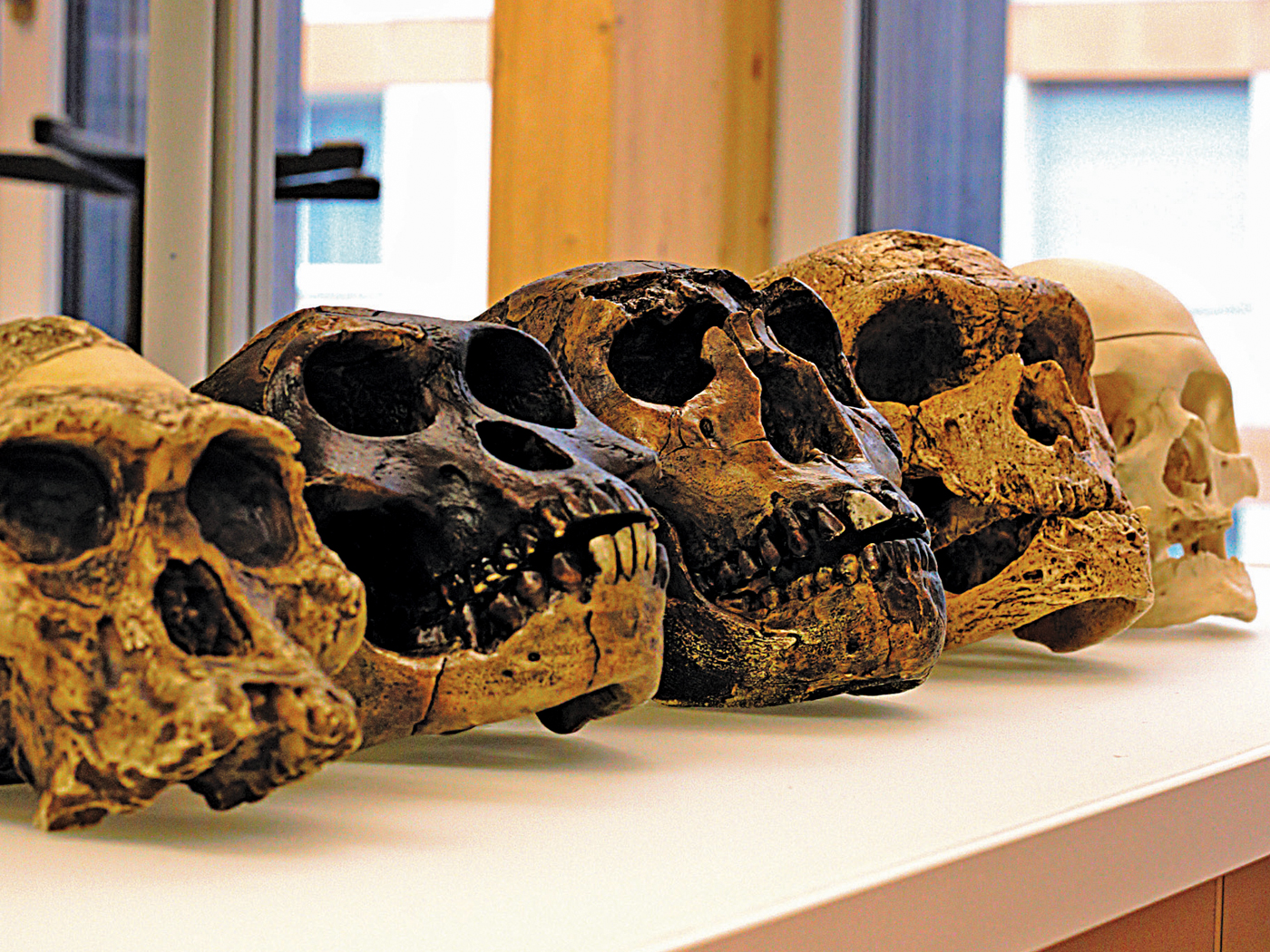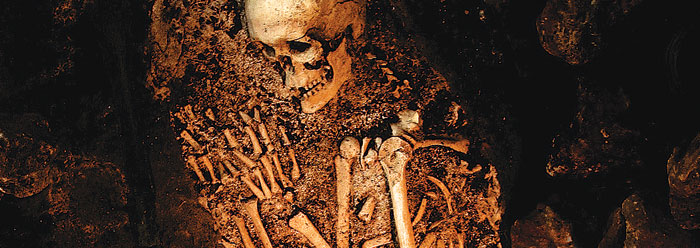
The first Neanderthal bones were unearthed in 1856 and were soon touted as supporting Darwin's 1859 theory of human descent from the animals. And ever since, Neanderthals have been presented as beetle-browed, bowlegged, brutes-half ape and half man. School students and museum visitors worldwide still believe that this "caveman" was a sub-human ancestor.
It surprises many to find out that in recent years, Neanderthal has been upgraded to fully human—an ethnic group with certain distinctive characteristics, but a bonafide member of Homo sapiens. The only controversy, which remains, is whether or not the Neanderthal group went extinct or merged with other humans.
The Homo sapiens designation was given after it was recognized that Neanderthals had, on average, a larger brain size than modern man, with a fully developed language center. Culturally, he cared for his sick and elderly, buried his dead, employed art and religious rites, appreciated agriculture, clothing, and music. His cultural level was "primitive" compared to twentieth century technology, but not all that different from many people groups worldwide in recent centuries.
So what do we make of the recent recovery of Neanderthal DNA which places him genetically outside the range of modern human ethnic groups?
Many from the media asked ICR if this didn't prove the evolution of man from the apes, but a close look at the real data actually supports the creationist view.
The DNA was recovered from the bone of the first Neanderthal discovered, an individual so riddled with rickets and old age that his legs had bowed. The DNA was mitochondrial DNA, not from the cell nucleus, and only 379 base pairs out of 16,500 (thus about 2%) of the total. It was found to differ from standard human mtDNA in 27 locations. Since modern human mtDNA differs on average in only eight locations within this stretch of 379, it was concluded that Neanderthals were probably not closely related to humans.
However, modern human mtDNA varies beyond the average, with the extremes statistically overlapping the Neanderthal measurement. Since all modern humans are interfertile, this measurement does not necessarily place them outside the family.
The technique is new and radical, and hopefully this measurement will be followed by others, which will give more insight and confidence. It would also be helpful to investigate Cro-Magnon bones of the same suspected date. This is breakthrough technology and both creationists and evolutionists would like to learn more.
From a creationist perspective, the Neanderthals were descendants of Noah—a language group that migrated away from Babel and found themselves in harsh "Ice Age" conditions with a meager lifestyle. Linguistic and geographic isolation may have produced a variant, but still human, genome. Whether they went extinct or interbred with others is not yet known, but from what we do know, they were as human as you and I.
*Dr. John Morris is President of the Institute for Creation Research.
Cite this article: Morris, J. 1997. Is Neanderthal in Our Family Tree? Acts & Facts. 26 (9).