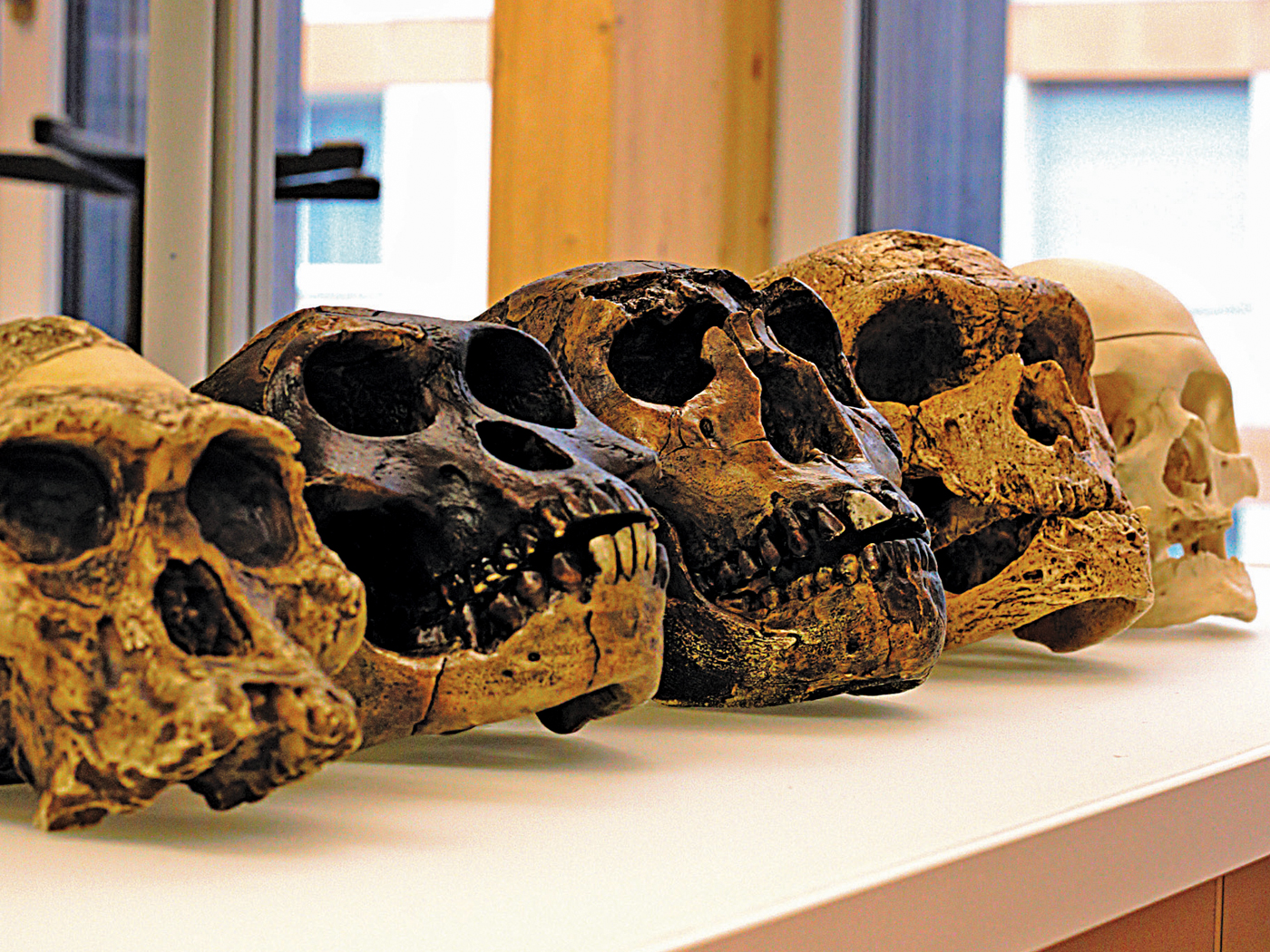
It's hard to keep them straight. First there was the discovery in Africa by Raymond Dart in 1925. of an infant skull. Entitled Australopithicus, this creature was recognized to be fully ape-like, but with a few characteristics hinting of human, thus an ape on the line to humans.
Over the years similar bones and bone fragments have been found (never has a complete skeleton been found) each individual slightly different but lumped into the genus Australopithicus, leading to the species names africanus, afarensis (including the famous "Lucy"), ramidus, and most recently ananemsis. A look at the actual data which led to the recent designation reveals the lengths to which men will go to justify their belief in our evolution from the animals.
Ananemsis has been dated as around 4 million years old by evolutionists. Leaving aside the validity of this date, we note that this age places ananemsis as older than the well-known "Lucy," a creature essentially identical to modern chimps, being totally chimp from the neck up. On her 3' 6" frame, only the controversial knee and hip bones give any clue of more erect posture than modem chimps. This species, as is now recognized, had long curved fingers and toes and an opposing big toe. With such a grasping foot, it was obviously tree-dwelling, only occasionally walking on the ground, possibly with a semi-erect posture).
The new ananemsis discovery consists of 2 groupings of bone fragments, together totaling 21. The more recent discovery of 12 tooth and jaw fragments near Lake Turkana in Africa have been lumped with 9 other fragments of teeth and limb bones found in 1965 and later some 100 miles away, near Kanapoi.
The Kanapoi fragments include one end of an arm bone, and the two end pieces of a shin bone, with the rest being tooth and jaw fragments. The arm bone was deemed remarkably "human-like" when discovered 30 years ago, strikingly close" to human in appearance, indistinguishable from modern homo sapiens."
But herein lies the problem. How could fully human limb bones be found in 4 million year-old strata? All evolutionists "know" that anatomically-modern humans didn't evolve-until the last one million years or so. How could they be before "Lucy," their ancestor? Thus the human-like arm bone was shelved. Only the recent discovery of the very human-like shin bone brought the arm to light once again, and forced evolutionists to deal with them both.
In contrast, the recently found Kanapoi jaw and tooth fragments are grossly apelike. Discoverer Dr. Meave Leakey (wife of Richard Leakey) exults that while the chin and teeth are more ape-like than "Lucy", yet they hint at progressing toward humans, thus earlier on the human family tree. (Doesn't anyone remember anymore that Lucy is scarcely different, from a chimp?). So, if this creature is more ape-like than Lucy, there is no justification for putting it in the human lineage at all).
The real clincher for evolution lies in the lumping of the recently found and quite ape-like 12 tooth and dental fragments from Lake Turkana in with the human-like Kanapoi limb bones, even though separated by 100 miles. Even at Kanapoi, the tooth and jaw fragments are found in a layer 55' lower stratisgraphically than the crucial limb bones. Already evolutionists are beginning to call the single-species interpretation into question. I predict that this claim will be discarded, even by evolutionists.
Meanwhile, Leakey's claims have received extensive coverage in the press. That may be what this is all about.
*Dr. John Morris is the President of ICR.