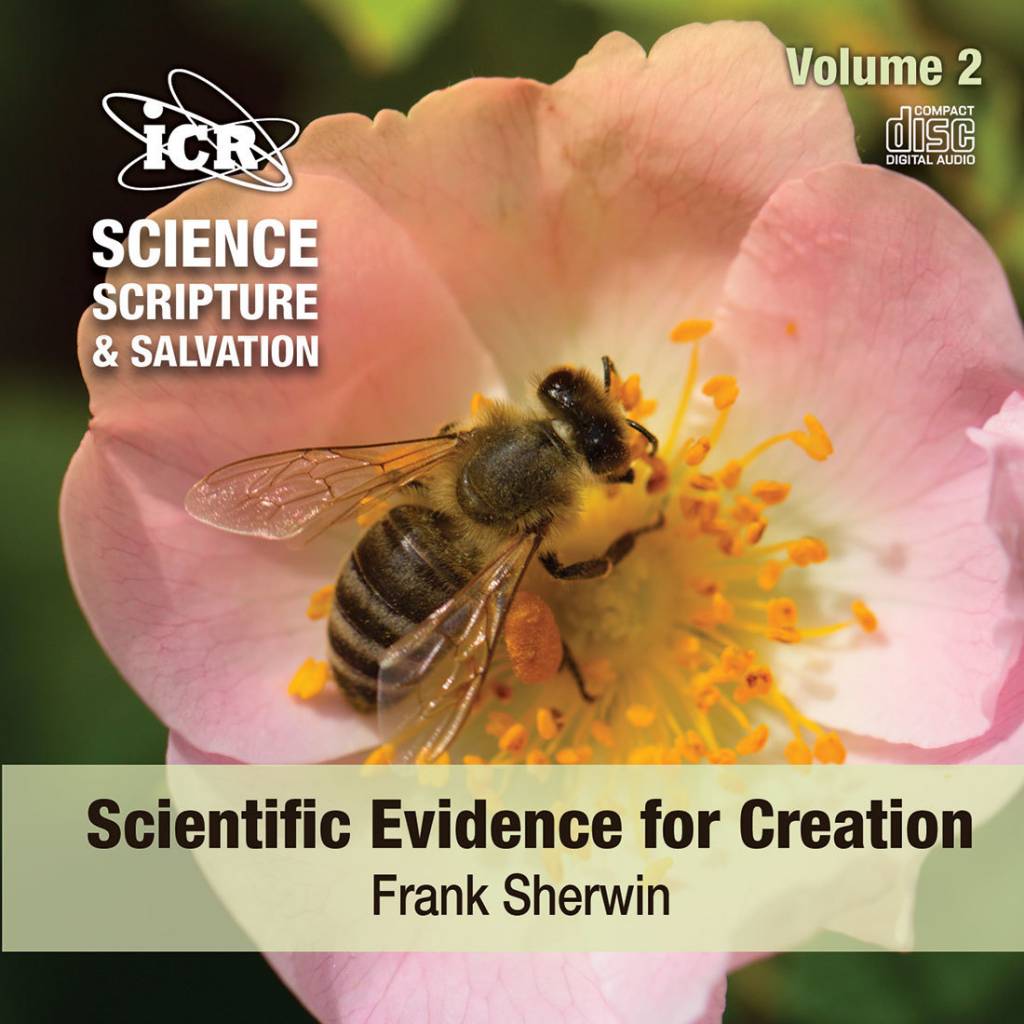
“These are, high, high, highly intelligent creatures,” said conservation biologist Reese Halter.1
Halter was speaking of the fascinating bee. Bees are already famous regarding their ability to communicate with other bees through complex dancing routines. Halter’s team also found that bees have puzzle-solving abilities. In 2006, scientists were amazed to discover that bees have a biological clock. They described it as, “An endogenous, physiological mechanism, whose exact nature has not been determined, that keeps time independently of external events.”2 It is actually more similar to humans than to insects.3
God designed bees with a brain the size of a grass seed, and yet they are quite intelligent. 
God designed bees with a brain the size of a grass seed, and yet they are quite intelligent. “Despite their tiny brains bees are capable of extraordinary feats of behavior,” said Dr. Nigel Raine, from Royal Holloway’s school of biological sciences at the University of London.4 The brain of the bee is composed of a mere one million neurons (nerve cells), compared to the approximately 86 billion neurons of a three-pound human brain. Entomologists are realizing that more brain size does not necessarily mean more intelligence. The answer may instead lie in the neural circuits, specifically the circuits’ interconnectivity and modularity.5 In other words, this demonstrates exquisite and precise design (Romans 1:20), the opposite of evolution’s time and chance.
Bees continue to astound scientists when tested for cognitive abilities in the lab.
Entomologists recently discovered that bees have a capacity to discriminate numbers. “Honeybees can identify a piece of paper with zero dots as ‘less than’ a paper with a few dots.”7 It has always been assumed that what separates man from the animal world (among other things) is an understanding of the abstract concept of “zero.” But Howard and his team have now shown that untrained honey bees have an understanding of an “empty set.” The authors stated, “Bees demonstrated an understanding that parallels animals such as the African grey parrot, nonhuman primates, and even preschool children.”
Loukola and his team concluded that the learning ability of bees is extraordinary.
Such unprecedented cognitive flexibility hints that entirely novel behaviors could emerge relatively swiftly in species whose lifestyle demands advanced learning abilities, should relevant ecological pressures arise.8
The tiny bee brain with its “unprecedented cognitive flexibility” reflects the Mind of the Creator.
The tiny bee brain with its “unprecedented cognitive flexibility” reflects the Mind of the Creator.
References
1. Hugo, K. Intelligence test shows bees can learn to solve tasks from other bees. PBS News Hour. Posted on pbs.org February 23, 2017, accessed June 10, 2018.
2. Allaby, M. 2020. Dictionary of Zoology. Oxford: Oxford University Press, 77.
3. Biological clock of honey bees more similar to human than to insects. AAAS. Posted on Eurekalert.org October 25, 2006, accessed June 10, 2018.
4. Bees’ tiny brains beat computers, study finds. The Guardian. Posted on theguardian.com October 24, 2010 accessed June 10, 2018.
5. Chittka, L. and J. Niven. 2009. Are Bigger Brains Better? Current Biology. 19 (21): R995-R1008.
6. Hugo, K. PBS News Hour. February 23 2017.
7. Howard, S. et al. 2018. Numerical ordering of zero in honey bees. Science. 360 (6393): 1124-1126.
8. Loukola, O. et al. 2017. Bumblebees show cognitive flexibility by improving on an observed complex behavior. Science. 355 (6327): 833-836.
Mr. Frank Sherwin is Research Associate, Senior Lecturer, and Science Writer at the Institute for Creation Research.