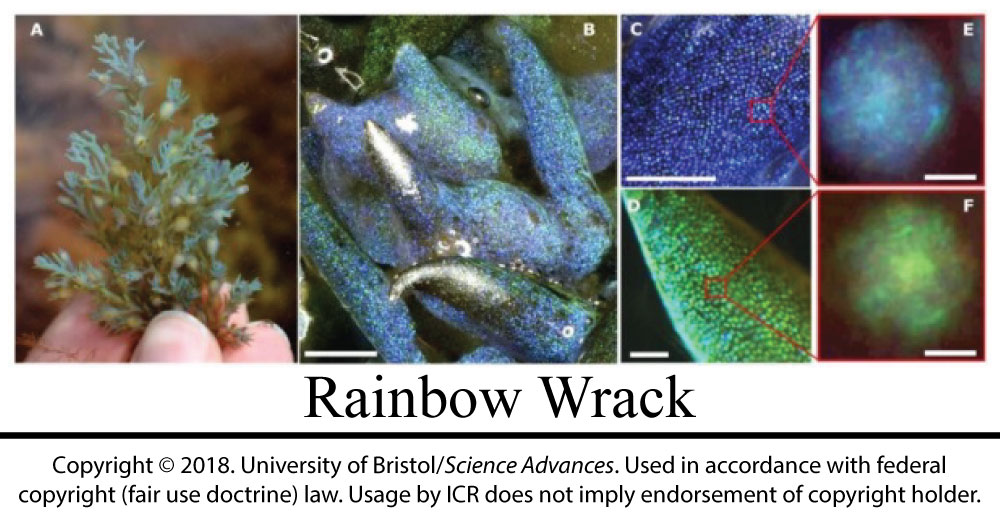
A common seaweed called rainbow wrack grows along Europe’s coasts, including tidal rock pools in the UK. Deep inside its cells, this marine plant uses oily chemicals to make opal look-alikes—“living opals.” This discovery intrigues nanotechnologists.
Opals are gemstones renowned for the way they make white light shimmer with thin rainbow colors. Deep inside the opals, light bounces off very tiny ball-like structures.1 A University of Bristol news release said, “Such structures arise from nanosized spheres packed tightly in a regular way.”2
Once an opal has formed in the earth, its nanostructure stays fixed. But this special seaweed can switch its rainbow production on and off on a daily basis. The seaweed cells craft and arrange ultra-tiny spheres in response to changing sunlight conditions during the day. Science Advances published the research.3
 Dr. Martin Lopez-Garcia, the lead author of the Science Advances report, told Bristol,
“If nanotechnologists were able to understand and mimic the dynamic properties of this seaweed opal, we may in the future have biodegradable, switchable display technology that may be used in packaging or very efficient, low cost solar cells.”
This common seaweed doesn’t use its oily opals as “display technology” to write messages on packages. It probably uses them in a way “that regulates the light reaching the chloroplasts,” according to the study authors.3 It certainly does “display” engineering that is so ingenious, efficient, switchable, and miniaturized that nanotechnologists long to discover how it works.
The study authors wrote in Science Advances, “The presence of such a complex photonic structure in an alga, such as the ordered 3D opal structure shown here, is surprising in itself but even more so is the fact that this complex structure is dynamic.”3
Bristol’s Dr. Ruth Oulton said, “So next time you’re rock pooling in the UK during your summer holidays, see if you can find this amazing seaweed with its nano-manufacturing technology.”
That which nature could never do, the Creator who exists outside of nature can do on a whim. 
If nature alone somehow gave this seaweed its “amazing” opalescence, then no wonder these researchers find it so “surprising.” But that which nature could never do, the Creator who exists outside of nature can do on a whim. Whoever could create light, morning, and evening on Day 1 of the creation week would also know how to make miniature machines—like living opals—that expertly manipulate and harvest light during mornings and evenings.
References
- They form fast from bacterial action underground. See Thomas, B. Opals Can Form in Weeks. Creation Science Update. Posted on ICR.org July 25, 2011, accessed April 18, 2018.
- New type of opal formed by common seaweed discovered. University of Bristol News. Posted on bristols.ac.uk April 17, 2018, accessed April 18, 2017.
- Lopez-Garcia, M., et al. Light-induced dynamic structural color by intracellular 3D photonic crystals in brown algae. Science Advances. 4 (4): eaaan8917.
*Brian Thomas is Science Writer at the Institute for Creation Research