




Introduction
Some of the most fascinating details of creation occur on the scale of the very small and the very large. Examples extend widely from the world of tiny living microbes to the vast regions of space. Everyday analogies and comparisons may be the best way to help us appreciate the rich diversity of creation all around us on the boundaries of observation. Four such examples are considered here, two taken from the microscopic world and two others from the opposite portion of the size range.
The Mole
The chemical mole, related to the word molecule, is a specific quantity of matter. One mole is defined as 6.022x10²³ elementary entities such as atoms of carbon or molecules of water. In words, a mole of water consists of about 600 billion trillion molecules. The numerical value is called Avogadro's number, named for Italian scientist Amedeo Avogadro (1776-1856). One mole of matter also is defined as the quantity of a substance whose mass in grams is the same as its molecular weight, taken from the periodic table. Examples of single mole quantities include 2 grams of hydrogen gas, H2; 18 gms of water, H2O; 32 gms of oxygen, O2; and 44 gms of carbon dioxide gas, CO2. One mole of any material, when converted to a gas, occupies 22.4 liters (0.8 cubic feet) at 0°C and one atmosphere of pressure (figure 1).
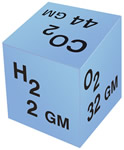
Figure 1. An illustration of one mole quantity of hydrogen (2 gm), oxygen (32 gm), and carbon dioxide (44 gm). A mole consists of 6.022x10²³ molecules, and one mole of any gas occupies 22.4 liters at 0°C and one atmosphere of pressure.
A single tablespoon of water weighs 15 grams, close to one mole. Therefore a single tablespoon of water contains a multitude of molecules numbering close to Avogadro's number. Consider the magnitude of this number:
- A copper penny (pre-1982) weighs about 3.1 grams. One mole of copper has a mass of 63.55 grams. Therefore a copper penny consists of 3.1/63.55 mole, a vast collection of about 3x10²² atoms, or 30 billion trillion atoms. Simply rubbing your finger across the surface of such a penny will loosen millions of invisible copper atoms.
- Suppose an Avogadro number of marbles could be spread over the surface of the earth. This quantity of marbles would result in a worldwide layer of marbles 50 miles (80.5 km) deep (Poskozim, et al., 1986).
- If the entire U.S. population (300 million people) spent 12 hours a day, 365 days a year, counting atoms at the rate of one atom per second, it would take about 127 million years to count the total atoms in one mole.
- Avogadro's number is more than 10 times the number of known stars in the universe. This number also exceeds the total of all the sand grains on the earth's seashores (DeYoung, 2002).
One mole of water, sand (silicon dioxide, SiO2), or any other part of creation consists of Avogadro's number of particles. The next time you take a swallow of water, measuring about one mole, think of the incredible number of water molecules involved, each one formed by the Creator.
The Nano-World
A nanometer is a length defined as one billionth of a meter. There are about 100,000 nanometers in the thickness of this page. The nano-scale currently is a very active area of science and technology. Microscopic devices under development include sensors, switches, motors, pumps, and robotics. In the coming years these tiny devices will revolutionize such fields as engineering and medicine.
- To glimpse the nano-world, consider the bacterial flagellum. This is a component of molecular motors which has been popularized in Intelligent Design discussions (Behe, 1996). Many bacteria grow flagella "propellers" which rapidly rotate as a means of propulsion through fluids. The length of the filament is typically a micrometer in size, or about one thousand nanometers. Bacteria and their flagella are at least one hundred times smaller than the thickness of a human hair.
- In one nanosecond, or 10-9 second, a pulse of light travels a distance of about one foot (30.5 cm). The new generation of optical computers operates on this ultra-short timescale.
- Fingernails grow at the rate of about one nanometer per second. In comparison, a "snail's pace" is high speed motion.
- A novel form of pure carbon occurs when 60 carbon atoms arrange themselves on the surface of a hollow sphere, similar to a microscopic soccer ball (figure 2). First discovered in 1985, these spheres are called fullerenes or "buckyballs." They are named for the architect Buckminster Fuller (1895-1983) who popularized geodesic domes in his building designs. The carbon spheres are about one nanometer in diameter. They may find application as bearings in motors built on the nano-scale. Buckyballs also have potential use as containers or "cages" for time-released medicine.
Bacteria with their molecular motors are by far the most abundant living organisms on Earth. Complex nano-structures such as buckyball carbon molecules have been found on the earth and in space. It is clear that the created micro-scale and nano-scale world is far ahead of current technology.

Figure 2. A spherical molecule of 60 carbon atoms, popularly called a buckyball. The sphere diameter is about one nanometer, or 10-9 meter. A single component carbon atom is ten times smaller. (Art created by Michael Ströck.)
The Sun
Scripture describes the sun as the greater light that rules the day. Just how great is our nearest star? Consider these illustrations:
- Imagine the sun as a flat, round disk in the sky. Now position images of planet Earth in a straight line across the sun's surface, somewhat like a string of beads. Between the edges of the sun, this string will consist of 109 beads or planet Earths. In other words, the earth is a small speck in comparison with sun size, 109 times smaller in diameter. Perhaps you have observed sunspots on the solar surface. These solar defects are typically larger than the entire Earth.
- Suppose the earth could somehow be placed at the center of the sun. Then the moon in its orbit would also be positioned inside the sun, about half-way out toward the sun's surface. The next time you look at the moon in the evening sky, 239,000 miles distant, consider this fact: If you were at the sun's center, then the moon also would be well within the sun.
- Suppose that the sun was a hollow sphere, somewhat like a basketball. How many planet earths could fit inside this hollow sun: one? one thousand? The correct answer is about one million planets (DeYoung, 2002). The million worlds would rattle around inside the sun like tiny seeds inside a basketball.
- The sun powers itself, at least partially, by nuclear fusion within its core. In this process the element hydrogen becomes helium. The sun's mass continually decreases as mass (m) is converted directly into energy (E), according to the relationship E = mc2, where c is light speed. The energy leaves the sun as light, heat, and radiation. The sun is "evaporating" itself away at the ferocious rate of five million tons of matter per second. This goes on day and night, year after year. Much more energy leaves the sun each second than mankind has produced since the Creation. Yet, the "fuel gauge" of the sun remains pinned on full. The sun has abundant hydrogen energy reserves to last throughout this age.
The sun is an average size star. Some stars are ten times smaller and are called brown dwarfs. Other stars are more than 100 times larger than the sun and are called red supergiants. In contrast, the sun has a size which is an ideal match for our needs here at home in the solar system. The sun truly is the greater light which rules our day.
The Light Year
Our final illustration on the large scale of creation is the astronomical measure of distance called the light year. This name is confusing because a light year measures length, not time. One light year is the distance light travels during an entire year in the vacuum of space, about six trillion miles or ten trillion km (actually 5.88x10¹² miles). A single light year can be visualized in the following ways.
- Twelve million round trips between the earth and moon would total a single light year.
- If you could travel nonstop at 8.5 million miles per hour during a lifetime of 80 full years, the distance would total about one light year. Our fastest space probes travel 500 times slower than this speed.
- The nearest night-time star, Alpha Centauri, is about 4.3 light years distant from Earth. Further away, the stars of the Big Dipper average 100 light years distance. The diameter of our Milky Way Galaxy is 100,000 light years. Current telescopes see outward to a distance of about 13 billion light years.
- Suppose that the entire Earth could be reduced to the size of a baseball. Then an equivalently-reduced light year would still extend about 50,000 miles outward.
We have completed our survey of several small and large extremes of creation, but we have only scratched the surface of possible objects to consider. Surely there are even more distant vistas, both smaller and larger, that we have not yet imagined. Our God, the Creator, has created them all from His omniscience and omnipotence. Truly the heavens declare the glory of God, and the firmament shows His handiwork (Psalm 19:1).
References
Behe, Michael. 1996. Darwin's Black Box. Touchstone Books, New York, p. 70.
DeYoung, Don. 2002. Astronomy and the Bible, Baker Books, Grand Rapids, p. 132.
Poskozim, P., J. Wazorick, P. Tiempetpaisal, and J. Poskozim. 1986. Analogies for Avogadro's number. Journal of Chemical Education, 63(2):125-126.
*Dr. DeYoung is an Adjunct Professor of Physics at the Institute for Creation Research.