A lioness at Yancheng Safari Park of Changzhou City in China gave birth last December to twin tigons. Unfortunately, one of them died soon after birth.1 Tigons are the rare products of tiger fathers and lioness mothers. Ligers come from lion sires and tigress mothers.
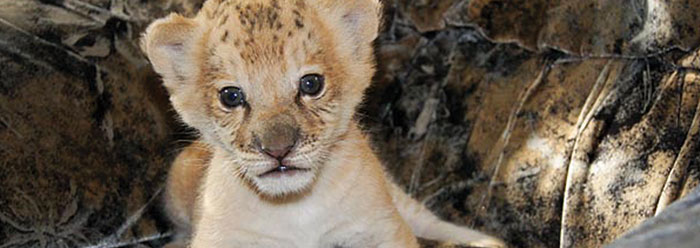
More recently, a female liger and African lion father produced perhaps the world’s first “liliger,” born at the Novosibirsk Zoo in Siberia.2 The liger mother had trouble producing enough milk, but fortunately a common housecat at the zoo “adopted” and nursed the tiny liliger, named Kiara. Kiara has a lion’s golden coat with some tiger stripes on her head.
What’s with all these unconventional cat categories? Tigons, ligers, and now liligers are all easily explained in the Bible’s historical context.
In short, lions and tigers can interbreed because they both descended from an ancestral cat family. Of course, not all cat varieties can interbreed directly like lions and tigers, but scientists place cats on a continuum of interbreeding varieties. For example, house cats can interbreed with small wildcats. They descended from the African wildcat, bred long ago perhaps near Egypt.3 Tigers can interbreed with leopards, leopards and pumas have interbred, pumas have interbred with members of the ocelot lineage, and certain ocelots are compatible with some domestic cats.4 All of this breeding potential clearly shows that differently named cats are simply varieties within the same basic cat kind.
This is exactly what one would expect from Genesis. God created cats to reproduce “after their kind” (Genesis 1:25). He also designed them to “multiply and fill” (Genesis 1:28) ever-changing environments. Could cat populations quickly and successfully interface with changing environments using an underlying system of genetic variability that uses a few simple changes?
Geneticists recently decoded just such a pattern. They screened king cheetah and similarly blotchy-striped tabby cat genomes. They found the same small genetic differences in all copies of an unexpected gene in both cat varieties. This simple change helped turn “ordinary stripes or spots into exotic blotches” many times in different cats, indicating genetic design.5
Body sizes, the relative sizes of body parts, and coat color and patterning differences can change in just one generation, like Kiara’s coat. These are not like the imagined wholesale changes that evolution would require to morph a cat into a different animal, but they are the sorts of changes that can facilitate a cat’s fit into a different niche. Plus, cat coat color variations reflect the Creator’s artistry.
Because these within-kind changes happen so fast, there is no scientific reason to doubt that cats produced very different-looking varieties very soon after the Flood. After reviewing cat hybridizations, fossil cat skeletons, molecular sequence data, fur color patterns, and cat-specific viruses, one recent study concluded, “It is reasonable to assume that all felids [cats] arose from a single founder species and that they have passed through one or more adaptive radiations, exploiting their inherent morphogenetic potential to produce all of the known extant and extinct species of cat.”6
Cats have unique differences, but they have always been cats—whether they are ligers, tigons, liligers, or tabbies.
References
- Tigon debuts in E China wildlife park. China Daily. Posted on chinadaily.com.cn February 29, 2012, accessed August 6, 2012. Note: The Associated Press recently released footage of the young cats in their pen. See Meliker, S. Lioness in China Gives Birth to Rare Tigon Cubs. VetStreet. Posted on vetstreet.com March 1, 2012, accessed August 6, 2012.
- Murphy, E. World’s First ‘Liliger’ is Born in Siberian Zoo. ABC News Blog. Posted on abcnews.go.com September 18, 2012, accessed September 30, 2012.
- The African wildcat, Felis lybica, is genetically similar to modern domestic cats. See Driscoll, C.A. et al. 2007. The Near Eastern Origin of Cat Domestication. Science. 317 (5837): 519-523.
- Thanks to Elian Koek of the Netherlands for helpful input.
- Norton, N. How the Tabby Got Its Blotches. ScienceNow. Posted on news.sciencemag.org September 20, 2012, accessed September 30, 2012.
- Pendragon, B. and N. Winkler. 2011. The family of cats—delineation of the feline basic type. Journal of Creation. 25 (2): 118-123.
Image credit: Novosibirsk Zoo
* Mr. Thomas is Science Writer at the Institute for Creation Research.
Cite this article: Thomas, B. 2012. Lions and Tigers, Tigons and Ligers. Acts & Facts. 41 (12): 17.