Many butterflies and moths have colors that show a metallic sheen. That sheen occurs because the refracting material in their wings and bodies is spread out in layers precisely as thin as the wavelengths of the light they refract.
Researchers recently found these delicate structures in moth fossils from Germany that are supposedly 47 million years old. But how could something that delicate last that long?
The authors of the study, which appeared in the online journal PLoS Biology, reported that the nanostructure of the tiny moth wing scales was still in very good condition, enabling the researchers to reconstruct their metallic coloration.
The report included electron micrographs of "bead-like spacers" less than one millionth of a meter in size. These spacers specify the tiny distances required to refract light. The "multilayer reflector" was still intact, almost like the moths were alive yesterday.1
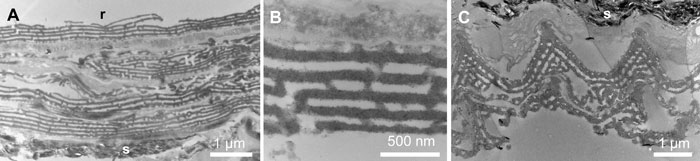
But who would expect that such detailed structures—so fine that researcher need an electron microscope to see them—persisted for a million years? If rock and soil covered the fossils over that length of time, then these delicate moth scale structures should have flattened long ago. However, if there wasn't much rock or soil on top of them, then oxygen gas would have reached them more easily and oxidized the scales, obliterating all their structure.
And the study authors examined original, not mineralized, biochemical constituents of the scales. They wrote:
Electron dispersive X-ray analyses demonstrate that the fossil scales are organically preserved: they comprise predominantly carbon and there is no evidence for replacement of the preserved tissue by authigenic [formed where found] minerals.1
Either flattened from pressure or obliterated by chemical reactions, the delicate and tiny moth wing fossil structures should be long gone if they are as old as the researchers claim. However, since they are still here and still identifiable, it makes more sense to say that they are only thousands of years old.
Reference
- McNamara, M. E. et al. 2011. Fossilized Biophotonic Nanostructures Reveal the Original Colors of 47-Million-Year-Old Moths. PLoS Biology. 9 (11): e1001200.
Image credit: Copyright © 2011 McNamara et al, PLoS Biology 9 (11): e1001200 (open access article, usage does not imply endorsement).
* Mr. Thomas is Science Writer at the Institute for Creation Research.
Article posted on January 5, 2012.