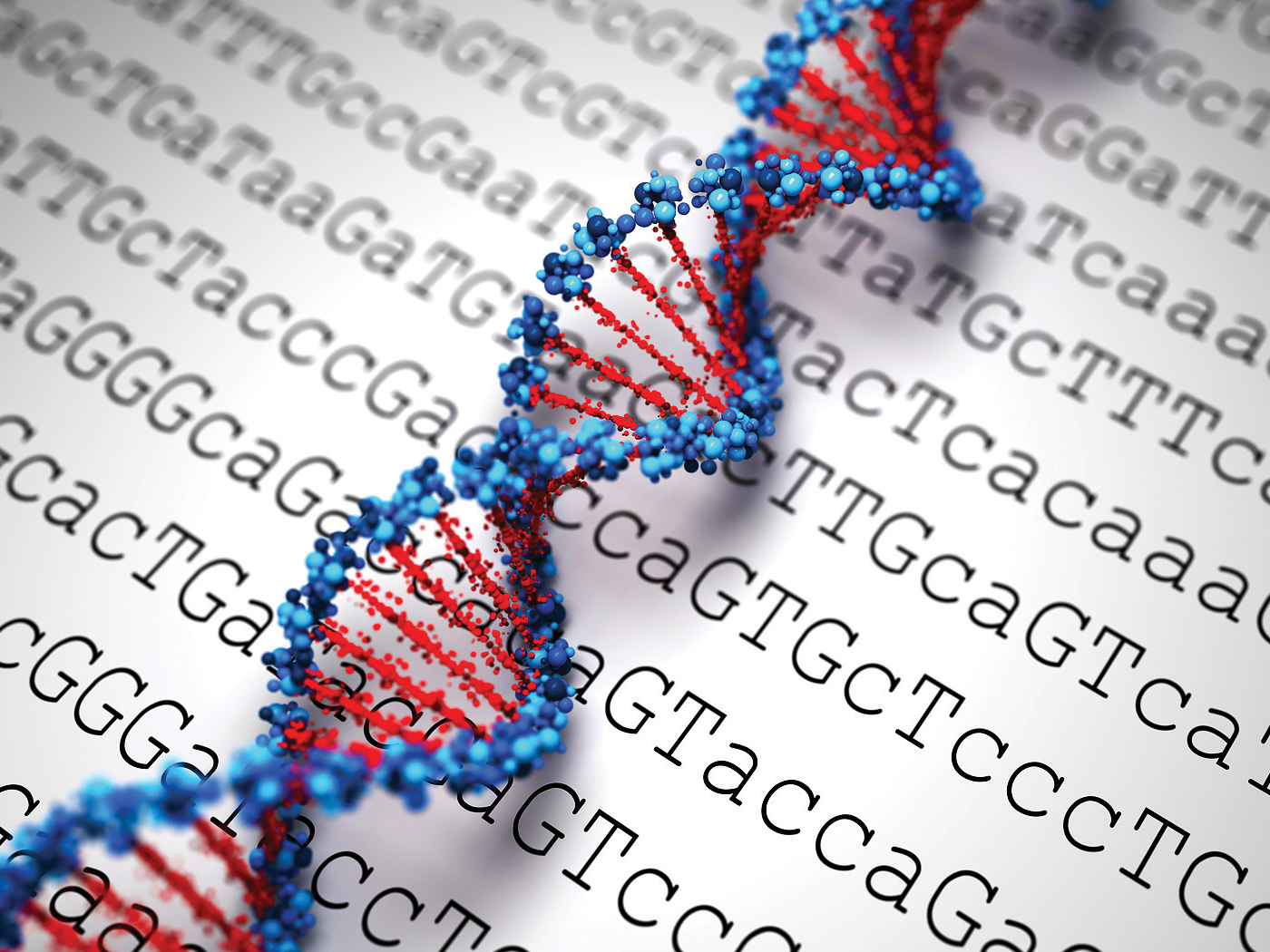
Researchers are still uncovering the amazing properties of DNA, the long molecule used by living systems to carry information. It is the densest data storage system known. With all that biological information packed into such a tiny space, shouldn't it be difficult to access or copy?
One reason that DNA can be so readily accessed by special proteins within cells is because DNA is able to flex without breaking. A team of physicists at the Institut Laue-Langevin recently investigated the flexibility of DNA by measuring how well it conducts sound waves. Their results were published in Physical Review Letters.
In a press release, ILL physicist Mark Johnson said, "We are essentially measuring the speed of sound in DNA which gives you a direct measurement of its structural flexibility."1 His team found that DNA has "a force constant of 83 N/m," close to that of nylon.2
This fundamental property enables DNA to be manipulated by proteins in multiple vital processes. For example, when DNA is copied, protein complexes race down its length, splitting the DNA double-helix like a zipper so that each resulting single strand can be quickly formed into a new double-stranded molecule. This occurs at jet-engine speeds, requiring DNA to have significant strength!3 If copying occurred much slower, then cells would not survive the wait.
Similarly, DNA is forcefully and rapidly unwound and scanned when RNA is manufactured. The protein complex that makes RNA molecules using DNA sequences as templates was referred to as a "molecular juggernaut" in a recent report in the journal Cell.4 Yet DNA is strong and flexible enough to withstand these hourly rigors.
The elasticity of DNA must fall within a limited range. If it were too stretchy, it would deform so much that essential proteins would not be able to latch on to or even recognize it. If it were too brittle, it would snap under the constant stresses of cellular life.
Thus, not only does the information on DNA demand an intelligent source, but so does the very construction of this remarkable molecule.
References
- Neutron scattering confirms DNA is as stretchy as nylon. Institut Laue-Langevin press release, via Alpha-Galileo, September 8, 2011.
- van Eijck, L. et al. 2011. Direct Determination of the Base-Pair Force Constant of DNA from the Acoustic Phonon Dispersion of the Double Helix. Physical Review Letters. 107 (8).
- Molecular Visualisations of DNA. Walter and Eliza Hall Institute of Medical Research online video. Posted on wehi.au, accessed September 9, 2011.
- Moore, M. J. and N. J. Proudfoot. 2009. Pre-mRNA Processing Reaches Back to Transcription and Ahead to Translation. Cell. 136 (4): 688-700. Cited in Thomas, B. 2010. Cell systems…what's really under the hood continues to drop jaws. Journal of Creation. 24 (2): 13-15.
* Mr. Thomas is Science Writer at the Institute for Creation Research.
Article posted on September 20, 2011.