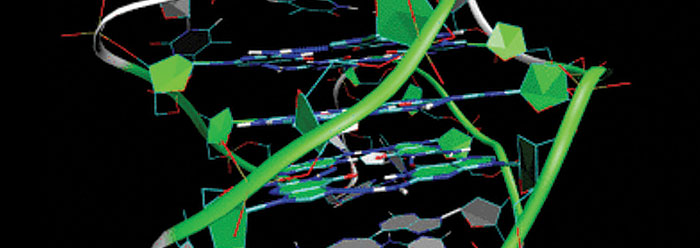
One of the recent cell biology and genetics projects at ICR has involved the compilation of years of research data on the cell’s telomere system in plants and animals, with an emphasis on its role in humans and in the intelligent design paradigm. The intriguing results of this extensive literature review…led by Dr. Jeffrey Tomkins in collaboration with Dr. Jerry Bergman…can be found in an upcoming issue of the Journal of Creation under the tentative title "Telomeres: implications for aging and evidence for intelligent design."1
The telomere system found in the cells of all plants and animals contains structural and dynamic features that protect the ends of linear chromosomes, making possible higher forms of cell life beyond that of single-cell bacteria. Scientists today have a very difficult time trying to account for the existence of linear chromosomes, much less telomeres. According to the general evolutionary argument, linear chromosomes, and hence telomeres, arose from the aftermath of some hypothetical cell cataclysm. As the story goes, one of the first primitive cells engulfed a bacterium and somehow pirated its circular chromosome for its own genomic purposes. At some point later in cellular history, perhaps even immediately after engulfment, the pirated circular chromosome suddenly fragmented into single linear pieces and miraculously…amidst all the chaos and in total violation of all known physical and chemical laws…formed the complex molecular end-cap apparatus now known as telomeres, albeit in a somewhat more primitive yet undefined state.
As with the many other insurmountable evolutionary transitions in the supposed rise and advancement of cells over time via materialistic and naturalistic processes, the miraculous black box of cataclysm and chaos is "scientifically" invoked as having mystically given rise to something new and improved. As rational biblical creationists, we see that this sort of reasoning is complete nonsense. In fact, when the most basic and elemental of all natural laws is considered, the law of cause and effect, the only logical conclusion for the highly engineered mechanisms found in cells, such as telomeres, is that an omnipotent Creator is the cause.
In humans, the telomere system is associated with a large number of age-related diseases, cancer cell biology, and cell longevity in general. Because of its association with cell longevity and human lifespan phenomena, the area of telomere research has received much publicity over the past 20 years in popular technical news reports. Understanding this unique cellular system may help to explain some aspects associated with the wide historical variation in human longevity, specifically the disparity of lifespans as described in the biblical record before and after the global Flood. In addition, the interdependence of the wide variety of components related to the telomere system in the cell provides an overwhelming case for both irreducible complexity and intelligent design.2,3
In our upcoming Journal of Creation article, we show how the telomere system is structured, how the various components of the system work, how other cell systems tie into the telomere apparatus, how telomeres play a role in disease and cell longevity, how epigenetic factors control telomere activity, and how the application of large-scale genomics research into telomere function has yielded exciting new discoveries. These fascinating data are coalesced into an apologetic argument for divine creation via the perspective of intelligent design. The end result is an overwhelming argument for divine engineering and biblical creation.
References
- Journal of Creation, a technical publication produced by Creation Ministries International, is available at creation.com.
- Behe, M. 1996. Darwin’s Black Box: The Biochemical Challenge to Evolution. New York: Free Press Publishers.
- Meyer, S. C. 2009. Signature in the Cell: DNA and the Evidence for Intelligent Design. New York: Harper Collins Publishers.
* Dr. Tomkins is Research Associate at the Institute for Creation Research and received his Ph.D. in Genetics from Clemson University.
Cite this article: Tomkins. J. 2011. Telomeres Get the Spotlight as Cellular Evidence for Intelligent Design. Acts & Facts. 40 (3): 6.