Often in lectures or articles creationists mention the impossibility of animals undergoing major body style transformations as required by evolution, such as an invertebrate acquiring a backbone and becoming an amphibian, or a reptile acquiring wings and becoming a bird, etc. Genetically, each feature requires a very specific suite of genes in its production and operation, and in none of these cases are the genes already present.
An invertebrate, like a jellyfish, a clam, or a worm, does not possess the genes necessary to construct a vertebral column, or to integrate it with all the other muscles, nerves, and organs needed by animals with a backbone, including fish, yet this transformation must have occurred if macroevolution is true.
Similarly, a functioning fish does not possess the genes necessary to construct and utilize legs. While some fish do have a few cartilage chips in their fins, these are not attached to the backbone by means of the pelvis or shoulder girdle necessary for standing. This doesn't even consider the host of muscles and nerve connections required for true legs or arms. Somehow, a fish would have to acquire a host of new, functioning genes to become an amphibian, a process unknown to science. Random mutations are the only proposed source, but these have never been observed to add useful genes to any genome.
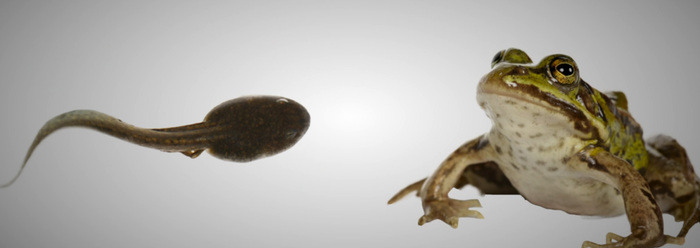
But what about tadpoles, which live in the water and have no legs, which change into land-dwelling frogs with legs? Surely metamorphosis is an example of evolution in action they say. Nothing could be further from the truth however.
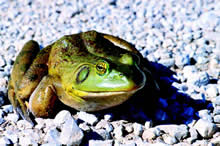 Keep in mind that tadpoles are not fish. They may superficially look somewhat like a guppy, but they are the offspring of fully functioning frogs, complete with all the genes for legs and the structures needed to use them. The tadpole is not yet fully grown, and in the incomplete stage has not acquired all the features present in the adult, but it is a juvenile frog nonetheless.
However, it does have all the genes needed for life in the water, as well as those genes needed to grow legs at the right time, then live on land, and eventually produce tadpoles which themselves become frogs. No new genetic information must be acquired by mutation as required by evolution. They are already present.
A similar sentiment could be made about a human fetus in its early stages. At one point it has no arms or legs (or eyes or lungs etc.) but it acquires them through genetically controlled growth. No evolutionary process is needed to transform a fertilized human embryo into a baby and then into an adult. All the genes are present at the start.
Neither growth nor metamorphosis are evolution. Such growth is the outworking of the Creator's majestic design for life.