Sharks have always held a fascination (and terror) for the average person. The gaping mouths of these eating machines hold row upon row of serrated, bone-crushing teeth. Sharks are a critical part of the marine ecosystem, living indicators of oceanic health. They have several roles, devouring decaying carcasses as well as feeding on other creatures that would otherwise reproduce out of hand.
Sharks undergo internal fertilization, a curiously advanced feature for animals supposedly 400 million years old. They also have the longest gestation period of any vertebrate--up to two years. Their adaptive immune system is unique in the animal world. Even the aforementioned teeth are an amazing piece of creative design, with new teeth developing inside the shark's jaw, and then moving forward to replace lost teeth.
The 850 species of sharks (in five living orders) range from the 49-foot whale shark to the 12-inch dwarf shark. Darwinists insist that sharks evolved, gradually appearing from unknown non-sharks in some distant evolutionary past. But in trying to piece together which shark forms evolved into the others, conflicting interpretations are the rule--as is the case with almost all other phylogenetic investigations across the living world.
As is also typical, an evolutionary scenario based on shark body shapes conflicts with the various studies based on shark molecules. "Molecular analyses of chondrichthyan phylogeny [shark evolution] so far do not support the morphological tree," wrote evolutionary paleontologist Michael Benton.1 Two evolutionists stated in Natural History, "We are limited to the [shark] fossils we happen to find, and these never give us the complete picture."2 Perhaps this is because the evolutionary "picture" only exists in the minds of men, not in the natural world.
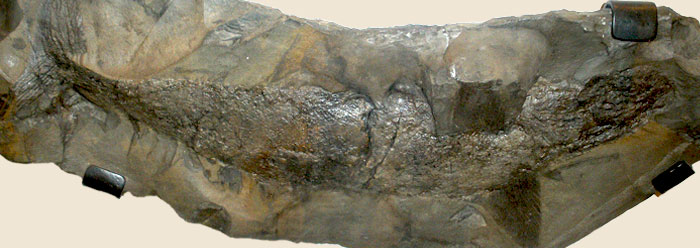
Cretaceous rock beds of Lebanon ("97-87 million years ago") have revealed many specimens of extinct skates, sawfishes, and guitarfishes, along with some sharks. All are essentially modern in appearance, with no sign of having evolved from something else. Considering the range of shark fossils, two evolutionary paleontologists said only that "a theory of relationships has been proposed."3 Traditionally, that theory has included the idea that cartilaginous fishes like sharks evolved into bony fishes. However, bony fishes have been found in Cambrian rocks, below those of the first shark fossils. How could sharks have evolved into these fishes if their fossils are in reverse order?
What about the extinct Devonian shark of the genus Cladoselache, held by many to be transitional? Evolutionists call it an oddball, yet it "was surprisingly modern-looking."4 Another extinct shark genus, Hybodus, has been interpreted as a shark ancestor. However, it appears suddenly in, and disappears mysteriously from, the fossil record. Vertebrate expert Barbara Stahl said that modern sharks "exhibit a mosaic of ancient, modern, and specialized structures,"5 which doesn't fit with an evolutionary explanation.
But mosaic structures are exactly what one would expect if creatures were created. Creation biologist Gary Parker stated in 2006:
According to the mosaic concept of kind, God used several different genes or gene sets over and over again in different combinations and proportions to make a variety of life forms, somewhat like an artist might use several different kinds of colored stones over and over in different proportions.6
Fossil or modern--sharks remain sharks. There is no truly scientific evidence that contradicts the Bible's assertion that sharks were created as a distinct kind on Day 5 of the creation week.
References
- Benton, M. J. 2005. Vertebrate Paleontology. Malden, MA: Blackwell Publishing, 165.
- Maisey, J. G. and R. Troll. 1998. Voracious Evolution. Natural History. 107 (6): 38-41.
- Schaeffer, B. and M. Williams. 1977. Relationships of Fossil and Living Elasmobranchs. American Zoologist. 17 (2): 293-302.
- Benton, M.J. 2015 Vertebrate Paleontology, Wiley Blackwell 173.
- Stahl, B. J. 1974. Vertebrate History: Problems in Evolution. Mineola, NY: Dover Publications, 185.
- Parker, G. 2006. Creation: Facts of Life. Green Forest, AR: Master Books, 48-49, emphasis in original.
* Mr. Sherwin is Senior Science Lecturer at the Institute for Creation Research.
Cite this article: Sherwin, F. 2009. Sharks Remain Sharks. Acts & Facts. 38 (8): 16.