Geologists now accept that catastrophic processes are necessary for the deposition of nearly all rock types. Only a short time was needed to form each bed of sediments (which eventually hardened into sedimentary rock). But how much time elapsed between the deposition of one bed and the deposition of an overlying bed? One clue is to recognize that the various features present on the top surface of each bed would not last very long if exposed. These features had to be covered rather quickly, before they had a chance to erode or be destroyed.
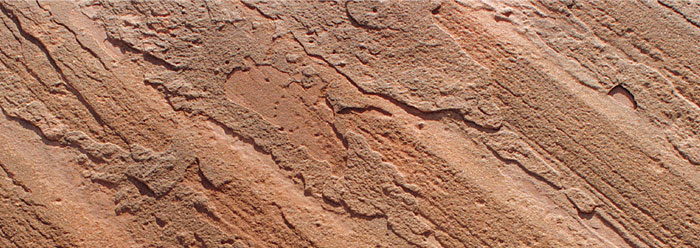
One very common feature, seen in many rock layers in many locations, is the presence of ripple marks, which form as water moves over a surface. These can frequently be seen on a beach after the tide has receded, and can also be seen on the ocean bottom where a particular current direction dominates. In many other places we see what have been called raindrop impressions, although these fragile markings may actually be blisters that formed as air bubbles escaped from rapidly deposited underwater sediments. Animal tracks are also common. In any case, these surface features, which had to be formed in soft sediment or they would not have existed at all, are very fragile, and if present on any surface--whether soft unconsolidated material or hard rock--will not last very long.
Keep in mind that almost every sedimentary rock layer was deposited under water. Every geologist agrees with this. Unless erosion dominates locally, sediments normally accumulate on an ocean bottom, lakebed, delta, beach, lagoon, stream bank, etc., in the presence of water currents. If subsequent events lift the deposit up out of the water, erosion and/or non-deposition will result. But if a zone stays under water, it will continue to be subjected to water action and will either receive more sediment or be eroded. In such an active environment, ripple marks can be preserved only if they are quickly buried by overlying materials, so that they are protected and thus have time to harden into rock.
In many places around the world, ocean-floor sediments have solidified into rock and are now uplifted onto continental surfaces. Ripple marks and similar features are readily seen in many locations, "frozen" into solid rock. Many examples come readily to mind for anyone who spends time out of doors. Sometimes one can observe several layers of rock stacked on top of one another, each displaying obvious ripple marks. The ripple marks in different layers may be in varied orientations, indicating that the water currents responsible for deposition shifted rapidly and erratically while deposition continued. There must have been a continued supply of sediments, but how could all the ripple marks be preserved?
If such a mark is exposed on any surface, under water or above water, it will soon erode and be washed away, especially in soft, unconsolidated sediments. Even on a hard rock surface, markings will erode in a few decades. There is no possibility that fragile features will last if unprotected for millions of years, waiting to be re-submerged and buried, and thus protected from destructive forces. We cannot determine exactly how much time passed between the deposition of two adjacent layers simply by looking at ripple marks, raindrop impressions, animal footprints, etc., but we can conclude that much less time passed than it takes for surface features to be eroded and disappear.
Since almost every layer gives demonstrable evidence of having been laid down rapidly and catastrophically, and since nearly all such catastrophic layers have surface features that were not eroded, one can reasonably conclude that the whole sequence of rocks was deposited by different episodes in a dynamic, water-charged, and sediment-laden event--such as the one described in Genesis 7 and 8.
* Dr. Morris is President of the Institute for Creation Research.
Cite this article: Morris, J. 2008. Surface Features Require Rapid Deposition. Act & Facts. 37 (12): 13.