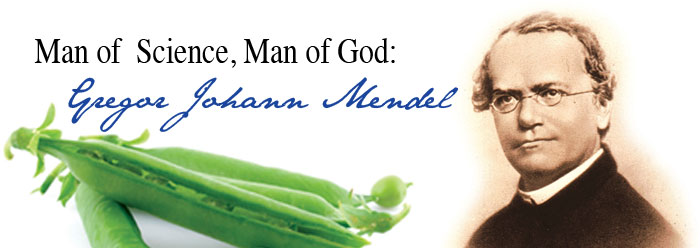
Who: Gregor Johann Mendel
What: Father of Modern Genetics
When: July 20, 1822 - January 6, 1884
Where: Heinzendorf, Hapsburg Empire (Modern-Day Czech Republic)
Gregor Mendel was an Austrian-born, German-speaking Augustinian monk who is famously known as the founder of the modern study of genetics, though his work did not receive much recognition until after his death.
He was born Johann Mendel to a peasant family in the village of Heinzendorf of the Hapsburg Empire, now known as Hyncice of the Czech Republic. As a child, he worked alongside his father to improve the family orchards by grafting, a practice encouraged and sponsored by the land's feudal proprietor, the Countess Maria Truchsess-Ziel.1 Since grafting was a particular "art" that produced both desirable and undesirable results, working in the orchards introduced the young Mendel to the beginnings of his experimental botany work.
When he was 11, Mendel's schoolmasters recognized his talent for learning and convinced his parents to let him pursue a higher education and, hopefully, a better vocation than the harsh life of a farmer. His parents were frequently unable to cover all of his living expenses in addition to paying his tuition, and he had to work to feed himself. Often he had to do without. In 1838, his father suffered a severe injury that prevented him from doing hard physical labor. The younger Mendel, at 16, then had to entirely support himself and his education.
He graduated from the "gymnasium" at Troppau on August 7, 1840, with high honors, taking first place in all his examinations. Between 1840 and 1843, he studied at the Philosophical Institute in the nearby city of Olomouc. Then, upon recommendation of his physics teacher, Father Franz, he entered the Augustinian Abbey of St. Thomas in Brünn (present-day Brno), adopting the name Gregor when he entered the monastic life.
He was sent to the University of Vienna between 1851 and 1853 to study botany, zoology, chemistry, and physics, and returned to the abbey in Brünn to teach. Between 1856 and 1863, he cultivated some 29,000 pea plants (Pisum sativum). The study showed that out of four plants, one received recessive alleles, two were hybrids, and one had the dominant alleles. His experiments were the foundation for two generalizations known today as Mendel's Laws of Inheritance. Based on his work, he produced the paper Experiments on Plant Hybridization and read it to the Natural History Society of Brünn in 1865. The society published the paper in its Proceedings in 1866.
Mendel's paper was rejected at first, since he evidently produced it as a counter to Darwin's theory of pangenesis, which was popular at the time and accepted as being responsible for inheritance.2 In 1868, Mendel was elevated to the position of abbot, and his scientific work was largely displaced by his administrative and ministerial responsibilities. He died in 1884 at the age of 61 from chronic kidney inflammation, and the abbot who succeeded him burned most of his papers.
In 1900, Mendel's work was rediscovered and is now the foundation of the science of genetics. In the past hundred years or so, his work has still received criticism and some have gone so far as to accuse Mendel of scientific fraud, even though his experiments have been recreated with the same results. Others have tried to shoehorn his work into the theory of modern evolutionary synthesis, which combines Mendelian genetics with natural selection and gradual evolution.
Though Mendel cannot speak for himself today and defend his work, his life as a priest testifies to his faith in the Creator God. After all, it is one thing to make confession in published books and papers, and it is another to dedicate one's life to those convictions.
References
- Mendel, G., A. Corcos, and F. Monaghan. 1993. Gregor Mendel's Experiments on Plant Hybrids: A Guided Study. New Jersey: Rutgers University Press.
- See Bishop, B. E. 1996. Mendel's Opposition to Evolution and to Darwin. The Journal of Heredity. 87 (3): 205-213.
* Ms. Dao is Assistant Editor.
Cite this article: Dao, C. 2008. Man of Science, Man of God: Gregor Johann Mendel. Acts & Facts. 37 (10): 8.