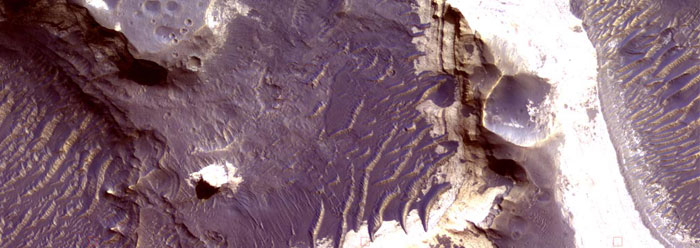
Despite 30 years of accumulating increasingly abundant and unequivocal geomorphological evidence, the case for past catastrophic water-related activity on Mars has remained controversial until very recently.1 Ingenious non-aqueous explanations had been proposed for individual Martian landforms that otherwise were strikingly similar to water-generated features on Earth. However, new developments resulting from robotic exploration of the surface of Mars have profoundly changed the consensus view, notably the nuclear physical measurement of abundant, extant, near-surface ice,2 and direct chemical analyses of aqueous minerals associated with sedimentary rocks.3
Channels and Valleys
Previously recognized channels and valleys extensively dissect the surface of Mars. The channels are elongated troughs that display clear evidence of large-scale fluid flow across their floors and along their walls. Immense channels, with widths of tens of kilometers and lengths up to a few thousand kilometers, have features that can only be explained by cataclysmic flows of water and sediment.4 On Earth, such flows produced the distinctive landforms of the Channeled Scabland of the USA's Pacific Northwest. An important recent discovery is that the Martian flood channel activity involved outbursts of water with huge discharges and associated lava flows.5
These huge Martian channels have now been recognized to be valleys that dissect the Martian highlands much more extensively than was apparent from earlier spacecraft-derived images.6 The Martian highlands consist of craters and impact basins that appear to have been extensively eroded by surface runoff processes.7 Large alluvial fans occur in the craters, being remarkably similar to low-relief terrestrial alluvial fans formed dominantly by fluvial processes.8 Furthermore, it has been discovered that the upper layers of the crust of the Martian highlands contain extensive sedimentary rocks that were deposited during intense denudation episodes.9 Cratering, fluvial erosion, and deposition of the sedimentary layers probably occurred contemporaneously, resulting in a complex interbedding of lava flows, igneous intrusions, sediments, buried crater forms, and erosional unconformities.
Surface Water Bodies
Evidence for past large bodies of water that covered the northern plains of Mars includes the morphological characteristics of sedimentary deposits and, more dramatically, a pattern of surrounding shorelines.10 These distinctive water-laid sedimentary layers, known as the Vistitas Borealis Formation, were deposited by a body of water which was approximately contemporaneous with the floods responsible for the largest outflow channels, and which covered an area of as much as three million square kilometers to average depths of hundreds of meters. The largest estimates involve as much as 20-60 million cubic kilometers of water, equivalent to 200-400 meters spread evenly over the whole planet and comparable to the inferred collective flows from the outflow channels.11
Even more compelling evidence supports the former existence of numerous lakes and seas, which were temporarily extant on the surface of Mars at various times in its history. Some lakes that filled highland craters held up to several hundred thousand cubic kilometers of water over an area of about one million square kilometers, the water spilling over to feed valleys, with peak discharge flows of millions of cubic meters per second over.12 Fluvial deltas are commonly associated with these paleolakes. Furthermore, some complexes of alluvial channels display paleo-meander topography that suggests these were laterally accreting rivers similar to the modern Mississippi.
What then happened to the huge quantities of water responsible for generating these channelized megafloods and relatively short-lived lakes and seas? The geomorphological evidence suggests that the water, even in the "Oceanus Borealis," was not on the Martian surface for prolonged periods. Instead it resided nearly all the time, except for brief spectacular episodes, within or beneath semi-permanent, ice-rich permafrost. This ice-rich layer, about 1-2 kilometers thick in equatorial areas and 5-6 kilometers thick at the poles, is documented by a variety of geomorphological features.13 These include various types of flow-lobed ejecta blankets, debris flows, lobate debris aprons, and polygonally-cracked terrains. Other landforms related to volcano-ice interactions14 document the short periods of volcanically induced outbursts from these reservoirs of ice and underlying ground water. Following these episodes, surface water seems to have very rapidly returned to these reservoirs.
Water and Glacier Related Landforms
Mars also displays other diverse suites of globally distributed landforms that are water related. Where observed on Earth these landforms are readily recognized to be of aqueous origins, involving dynamic hydrological cycling. Perhaps the most striking of these are the numerous small gullies developed on hillslopes associated with crater rims and channel or valley walls, their morphological similarity to terrestrial counterparts suggesting formation by aqueous debris flows involving the melting of near-surface ground ice.15 Very distinctive debris flows occur on the debris-mantled slopes of large sand dunes, most likely produced by water-sediment mixtures.16
Glaciated landscapes are some of the most important Martian landform features now documented. The growth and persistence of large glaciers required a dynamic hydrologic system that moved large quantities of water from surface-water reservoirs, such as lakes and seas, through the atmosphere to sites of precipitation. The Martian glacial landforms include erosional grooves, streamlined/sculpted hills, drumlins, horns, cirques, tunnel valleys, depositional eskers, moraines, kames, ice-marginal outwash plains, kettles, and glaciolacustrine plans.17 These landforms occur in spatial associations that exactly parallel terrestrial glacial geomorphological settings.
Sedimentation and Diagenesis Features
Sedimentary structures examined during recent robotic exploration of the Martian surface also provide evidence of aqueous depositional processes on Mars.18 The layering in the sandstone exposed in the interior wall of a crater was found on closer imaging to be millimeter-scale laminations.19 The sand consists of altered basaltic mud grains, so this finely laminated sandstone is reminiscent of the similar sediments that were catastrophically deposited at Mount St. Helens.20 Fine-scale trough or festoon cross-lamination also present confirm the action of surface water.
Hematite-rich concretions within outcrops would have formed during diagenesis in a groundwater/brine-saturated environment. Microtextural features preserved in the sandstone are also consistent with diagenetic processes commonly associated with groundwater recharge and evaporation. These include early pore-filling cement leading to primary lithification, post-concretion cement resulting from recrystallization and new growth, and millimeter-scale voids interpreted to be secondary porosity.
Conclusions and Implications
There is no longer any doubt that the surface of Mars has in the past been covered by huge volumes of water which spread over vast areas. These resulted from cataclysmic outflows, which were also responsible for catastrophic erosion of channels and valleys, on a scale far greater than anything comparable on Earth, and deposition of sedimentary strata. It appears that much of this water still resides near the Martian surface in permafrost and as ice. Mars has in the past also experienced huge volcanic eruptions and vast lava outpourings across its surface, perhaps on a greater scale than those on the earth.
There is an irony in the obvious parallels with the earth. Most geologists today vehemently oppose any suggestion that in the earth's past there were cataclysmic outbursts of water that flowed catastrophically across its surface as the global Genesis Flood, even though planet Earth is still 70% covered in water. Yet they are equally adamant that the surface of nearby planet Mars has in the past been cataclysmically covered in water, even though most of its surface is now dry. However, the evidence on both planets is the same -- landforms carved and sedimentary strata deposited catastrophically. Obviously their conclusions are based on a belief in uniformitarianism ("the present is the key to the past"), not the evidence which is consistent with the Bible.
References
- Baker, V. R. 2006. Geomorphological evidence for water on Mars. Elements 2:139-143.
- Boynton, W. V., et al. 2002. Distribution of hydrogen in the near surface of Mars: Evidence for subsurface ice deposits. Science 297:81-85.
- Squyres, S. W., et al. 2004. In situ evidence for an ancient aqueous environment at Meridiani Planum, Mars. Science 306:1709-1714.
- Baker, V. R. 2001. Water and the Martian landscape. Nature 412:228-236.
- Berman, D. C., and W. K. Hartmann. 2002. Recent fluvial, volcanic, and tectonic activity on the Cerebus Plains of Mars. Icarus 159: 1-17.
- Hynek, B. M., and R. J. Phillips. 2003. New data reveal mature integrated drainage systems on Mars indicative of past precipitation. Geology 31:757-760.
- Craddock, R. A., and A. D. Howard. 2002. The case for rainfall on a warm, wet early Mars. Journal of Geophysical Research 107(E11):5111, doi: 10.1029/2001JE001505.
- Moore, J. M., and A. D. Howard. 2005. Large alluvial fans on Mars. Journal of Geophysical Research 110:E04005, doi: 10.1029/2004JE002352.
- Malin, M. C., and K. S. Edgett. 2000. Sedimentary rocks of early Mars. Science 290:1927-1937.
- Clifford, S. M., and Parker, T. J. 2001. The evolution of the Martian hydrosphere: implications for the fate of a primordial ocean and the current state of the Northern Plains. Icarus 154:40-79.
- Boyce, J. M., et al. 2005. Ancient oceans in the northern lowlands of Mars: Evidence from impact crater depth/diameter relationships. Journal of Geophysical Research 110:E03008, doi: 10.1029/2004JE002328.
- Irwin, R. P., et al. 2004. Geomorphology of Ma'adim Vallis, Mars, and associated paleolake basins. Journal of Geophysical Research 109:E12009, doi: 10.1029/2004JE002287.
- Kuzmin, R. O. 2005. Ground ice in the Martian regolith. In T. Tokano (ed.), Water on Mars and life (pp. 155-189). Heidelberg, Germany: Advances in Astrobiology and Biogeophysics, Springer.
- Chapman, M. G., et al. 2000. Volcanism and ice interactions on Earth and Mars. In T. K. P. Gregg and J. R. Zimbelman (eds.), Deep oceans to deep space: environmental effects of volcanic eruptions (pp. 39-74). New York: Plenum.
- Malin, M. C., and K. S. Edgett. 2000. Evidence for recent groundwater seepage and surface runoff on Mars. Science 288:2330-2335.
- Mangold, N., et al. 2003. Debris flows over sand dunes on Mars: Evidence for liquid water. Journal of Geophysical Research 108(E4), doi:10.1029/2002JE001958.
- Kargel, J. S. 2004. Mars: A warmer, wetter planet. Chichester, UK: Springer-Praxis.
- Jollif, B. L., et al. 2006. Evidence for water at Meridiani. Elements 2:163-167.
- McLennan, S. M., et al. 2005. Provenance and diagenesis of the evaporite-bearing Burns Formation, Meridiani Planum, Mars. Earth and Planetary Science Letters 240:95-121.
- Austin, S. A. 1986. Mount St. Helens and catastrophism. In Proceedings of the first international conference on creationism 1:3-9. Pittsburgh, PA: Creation Science Fellowship.
*Dr. Snelling is a Professor of Geology in the ICR Graduate School.
Cite this article: Snelling, A. 2007. Water Activity on Mars: Landscapes and Sedimentary Strata. Acts & Facts. 36 (2).