Often those who prefer non-Darwinian explanations for the origin of the species are accused of being unscientific. One may believe in creation (or intelligent design), evolutionists maintain, but there certainly isn't any evidence for it. Ironically, it is research by the scientific community that begs to differ, revealing stunning and sophisticated features of the living world:
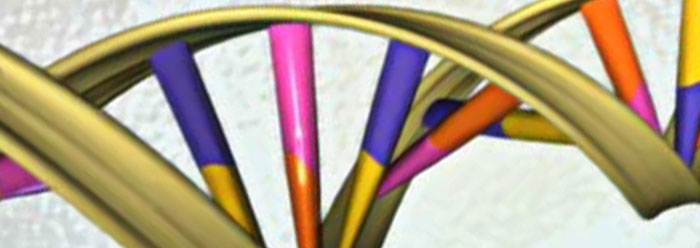
DNA's simple and elegant structure -- the "twisted ladder," with sugar-phosphate chains making up the "rails" and oxygen- and nitrogen-containing chemical "rungs" tenuously uniting the two halves -- seems to be the work of an accomplished sculptor.
Yet the graceful, sinuous profile of the DNA double helix is the result of random chemical reactions in a simmering, primordial stew. Just how nature arrived at this molecule and its sister molecule, RNA, remains one of the greatest -- and potentially unsolvable -- scientific mysteries.1
There are a number of points of note in this remarkable quote. The most obvious is that judging simply by what the secular scientist can see (Romans 1:20), DNA has all the earmarks of a Sculptor who is gifted, skilled, and clever. But then notice they deny what is "clearly seen" choosing to attribute the "graceful, sinuous profile" of DNA to "a simmering, primordial stew." In 1952 a graduate student in Chicago attempted to emulate prebiotic conditions on a young Earth "billions of years ago." But organic life and DNA were never "created."2 What biochemists cannot do given almost unlimited funding, time, and contact with the brightest and best scientific minds in the world -- a "simmering, primordial stew" can do! There have been other simulation experiments, but no one has been able to make "the sugar molecules dioxy-ribose |sic| and ribose necessary to build DNA and RNA molecules."3
"Random chemical reactions" are not what any biochemist would bet on when making something as detailed as DNA, even in the fullness of time. Recent discoveries have added even more woes to the primordial stew hypothesis.4
If the origin of DNA/RNA continues to remain "one of the greatest -- and potentially unsolvable -- scientific mysteries" then the door is wide open to a supernatural explanation. Questing, unbiased scientists should be free to go down that path. Darwinists are hoping that some day a purely chemical explanation for the origin of the complex DNA molecule will miraculously appear, but that day will never come.
References
- Physorg.com. 2006. Uncovering DNA's "sweet" secret. October 3, 2006. http://www.physorg.com/news79110174.html
. - Meyer, S. Spring 1996. The origin of life, The Intercollegiate Review 31:26.
- Ibid.
- Kerr, R. A. October 6, 2006. Has lazy mixing spoiled the primordial stew? Science 6 314:36-37.
*Frank Sherwin is a zoologist and seminar speaker for ICR.
Cite this article: Sherwin, F. 2007. DNA: A Stew-pendous Creation. Acts & Facts. 36 (1).