
This question often crops up among evolution disbelievers. And while it underscores the truth that most people truly don't believe man came from rats, fish, and single-celled organisms up through the primates, it ignores the fact that evolutionists have a ready answer to it.
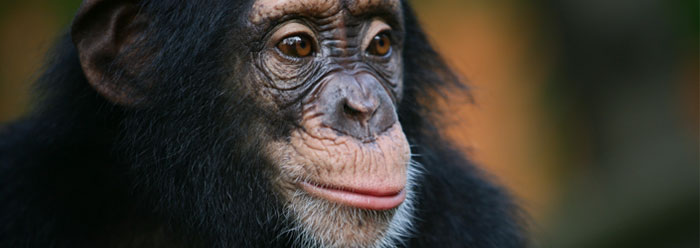
First, evolutionists strongly deny the idea that men came from the apes. They insist that both man and the apes came from a hypothetical ape-like ancestor, the evidence for which has not yet been discovered.
Secondly, evolution does not propose that all members of a type evolved into another type, but that only a small group of individuals, genetically isolated from the others, evolved, leaving the others to remain the same.
A perceptive person will recognize that both of these points are nothing more than story telling. The hypothetical ape-like ancestor does not exist, and there is no evidence that it ever did. The "peripheral isolates" claim may sound reasonable, and there are recent examples of isolated groups acquiring new traits through adaptation, but none of any group acquired new suites of functioning genes through random mutation, such as production of either an ape or a man from an ape-like ancestor would require.
Instead of asking why we still have apes, we should be asking why don't we have the hypothetical ape-like ancestor, the real missing link? Or, why don't we have the required intermediate forms? How can such change happen? The claim that transitional individuals were few in number, and thus unlikely to be fossilized and discovered, rings hollow. The fact is, we don't have them! The evolution claims are only stories. In their story, man and apes diverged from the imaginary ancestor some seven million years ago. Surely some would be fossilized.
We should also ask, how could such a transition happen? The only way we know to acquire new genes is to alter existing genes through random mutation. The best alteration science has observed has produced only novel recombinations -- most deteriorate the genetic information and thus harm the offspring. Many mutations are fatal. Evolution requires trillions of innovative mutations to produce man from lower forms, and at least millions to produce man or apes from an ape-like ancestor. None have been observed.
Evolution tales are pseudo-scientific stories about an imaginary history. Evolution is best understood as an anti-God origins myth, attempting to explain man's existence without a Creator. We can do better.
*Dr. John D. Morris is the President of the Institute for Creation Research.