Do analyses of the radioactive isotopes of rocks give reliable estimates of their ages? That is a good question, which ordinarily requires a lengthy and technical answer. In order to give an initial response, we might confine our attention to dating of lava flows, the most easily dated rocks, and limit our discussion to the Grand Canyon, which contains thoroughly studied lava flows profoundly relevant to the creation/evolution question. Furthermore, we might begin by focusing our investigation to "wholerock" potassium-argon (K-Ar) and rubidium-strontium (Rb-Sr) techniques, the two most popular methods for dating rocks.
Popular Dating Methods
Both the K-Ar and Rb-Sr methods make use of radioactive decay of a parent isotope to a stable daughter isotope. Potassium-40 (40K), common in minerals of volcanic rocks, decays to argon-40 (40Ar), a gas which can remain trapped within minerals of volcanic rocks. Rubidium-87 (87Rb), common in minerals of volcanic rocks, decays to strontium-87 (87Sr), an isotope which can remain fixed in the atomic lattice structure of common minerals in volcanic rocks. The decay relationshipof 40K and 87Rb can be expressed mathematically in terms of time, t, the number of years which have elapsed. For Rb-Sr dating, the well-known equation is:
87 S rp = 87 Sro + 87Rbp (elt -1) &
nbsp; (1)
where 87Srp and 87Rbp are the number of atoms of 87Sr and 87Rb presently in the rock, "Sro is the number of atomsof 87Sr initially in the rock when it cooled from the lava flow, e is the natural base of logarithms (2.71828...), l is the decay constant of 87Rb in units of reciprocal years (1.42xl0-11 y -1 is the currently accepted value),1 and t is the "age," the time elapsed in years since the rock crystallized by cooling of the lava flow. A similar expression can be derived for the decay of 40K to 40Ar. Using equation (1), a "model date" for one whole rock analysis can be derived if l is assumed to be constant through time, if Sro can be determined, and if no outside addition or loss of 87Sr or 87Rb has occurred since the rock cooled from the lava flow.
The analytical equipment used to determine the abundances of isotopes is more accurate in determining ratios of isotopes than their absolute abundances. Therefore, 40Ar is often analytically determined in relation to 36Ar, an isotope not formed by radioactive decay, and 87Sr is often determined in relation to 86Sr, another isotope not formed by radioactive decay.
Thus, equation (1) can be transformed into a more useful expression for Rb-Sr dating:
(87 Sr/ 86 Sr)p = (87Sr/86 Sr)o + (elt-1) (87Rb/86Sr)p &nbs
p; (2)
Notice that this equation has the familiar mathematical form of a straight line y = b + mx. A graph having 87Rb/ 86Sr as the x-axis and 87Sr/86Sr as the y-axis would allow the isotope ratios of all rocks in a lava flow to be plotted. The Rb-Sr ratios in various rock samples from the same lava flow might differ, but all should plot as a straight line on the graph if the lava was isotopically homogeneous (each rock sample had the same initial 87Sr/86Sr ratio) and each rock remained closed to gain or loss of rubidium and strontium since crystallization. In the ideal case, multiple samples from the same lava flow should plot perfectly along a line with slope elt-1. The slope of the line should increase with age because in elt-1 increases as t increases. Initially, as the lava flow cools, t = 0 and elt-1 = 0; a horizontal line plots on the graph and all samples have the same 87Sr/86Sr value. As time passes, t > 0 an elt-1>0, a line with positive slope plots on the graph, and samples with greater initial 87Rb/86Sr have greater 87Sr/86Sr after time passes.
Graphs of 87Sr/86Sr versus 87Rb/86Sr and 40Ar/36Ar versus 40K/36Ar give lines whose slopes supposedly reflect the ages of lava flows. Such ages defined by these fines are called "isochrons." An "isochron date," which relies on multiple rock samples, is considered to be much more reliable than a "model date" determined from a single rock sample. Isochron confidence is well founded, for the assumptions of the dating method appear to be internally verified. The y-intercept of the isochron is the initial 87Sr/86Sr value and the correspondence to a straight line measures the degree to which the lava has remained a "closed system." "Model dates" have no check for internal consistency.
Grand Canyon Lava Flows
Two lava flow formations occur in the Grand Canyon, the Cardenas Lavas and the Western Grand Canyon lava flows. Both are basalts. The Cardenas Lavas are believed to be among the oldest strata of the Grand Canyon, occurring underneath 10,000 feet of strata in the eastern Grand Canyon. They have been assigned to the Precambrian strata of the Unkar Group, which contains the lowest and hence oldest strata of the Grand Canyon. Three whole rock K-Ar dates by McKee and Noble2 gave ages for Cardenas Lavas of 810±20, 790±20, and 781±20 million years. Two whole rock K-Ar analyses by Ford, Breed, and Mitchel3 gave an average age of 845 ± 15 million years.
 |
 |
| RUSIDIUM-87/STRONTIUM-86 | RUBIDIUM-87/STR(>NTIUM-86 |
|
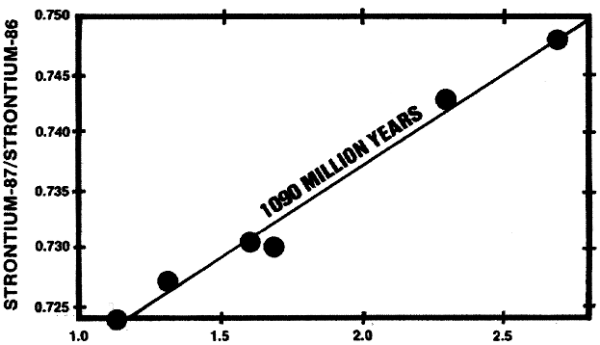
Figure 1. Rb-Sr "isochron" for deeply buried Cardenas Lavas of the Eastern Grand Canyon, The slope of the line indicates an age of 1090 million years and overturned five K-Ar "model dates." |
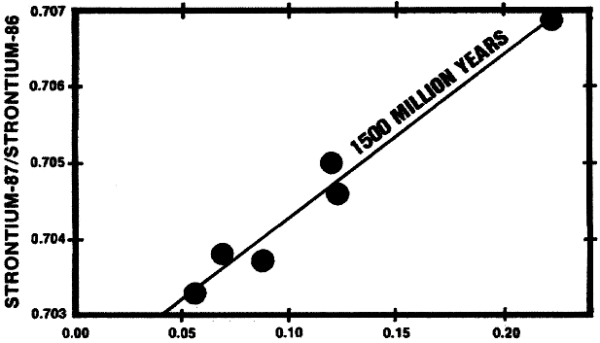
Figure 2. Fictitious Rb-Sr isochron for the Western Grand Canyon lava flows. AJthough the lavas flowed over the rim and into the Grand Canyon, the "isochron" age of 1500 million years would make these youngest lava flows among the oldest rocks yet dated in the Grand Canyon. |
All five analyses by the K-Ar method would appear to limit the age of the Cardenas Lavas to somewhere between 760 and 860 million years, except for the fact that a discordant Rb-Sr isochron was obtained by McKee and Noble 4 of 1090 ± 70 million years. Figure 1 shows the analyses of six samples which plot nicely along a line and seem persuasively to describe an isochron. Geologists, understandably, have accepted the Rb-Sr "Isochron date" for the Cardenas Lavas and attribute the younger K-Ar "model dates" to be errors caused by uniform argon loss by these rocks after the lava cooled.
The Western Grand Canyon lava flows are among the youngest formations of the Grand Canyon. These flows came from volcanoes on the Ulnkaret Plateau north of the Colorado River. Some of the lava flowed over the north rim, cascading into Grand Canyon, forming spectacular "frozen" lava falls. Several lava flows even reached the river, forming lava dams. Although no Indian legends attribute them to recent eruptions, one early geologist remarked about the extraordinary freshness of lava: "It looks as fresh as any coulee of Vesuvius ejected twenty or thirty years ago."5 One K-Ar "model age" determination gave 1.2 ± 0.2 million years6 for the lava dam, and geologists consider these lava flows to be Pleistocene in age.
Using data on rubidium and strontium from the Western Grand Canyon lava flows published by Leeman,7 we can construct an isochron for these lavas. Six Pleistocene lavas from Uinkaret Plateau (Stages III and IV of Hamblin's later classification)8 indicate a line appearing to form a good isochron in Figure 2, the slope determining an "age" of 1500-million-years. The correlation of these six points to the 1500-million-year isochron is almost as good as the six points forming the 1090-million-year isochron for the Cardenas Lavas (Figure 1), which overturned five K-Ar "model dates." Geologists, however, must reject the alleged "isochron" for the Western Grand Canyon lava flows (Figure 2) because these most recent flows would otherwise appear to be the oldest rocks of the Grand Canyon. No geologist could accept the erosional form of the Grand Canyon as enduring for 1.5 billion years!
Fictitious Isochron Ages
The isochron method assumes that the datable lava flow cooled from molten rock having different Rb/Sr ratios but having uniform mixing isotopically (all samples having the same 87Sr/86Sr ratio). What if the strontium in the lava was not isotopically homogeneous when the flow cooled? The answer to this question has been summarized by Gunter Faure. According to Faure,9 the incomplete mixing of two magmas having different strontium isotope ratios produces a mixing diagram where all mixtures lie on a straight line on an 87Sr/86Sr versus 87Rb/86Sr graph with the slope of the line having no identifiable time significance! Such two-component mixing diagrams produce what Faure calls "fictitious isochrons." Another geologic cause for these straight line plots is offered by Brooks, James, and Hart.10 They document twenty-two examples of false rubidium-strontium isochrons and propose that such characteristics are inherited from the molten material's source at great depth in the earth. The straight line plot is again explained by geologic process, not by time-dependent nuclear decay within the rock.
A probable cause of the fictitious isochron ages of Grand Canyon lava flows will be offered in a future Impact article. A critique of the Cardenas Lavas isochron will be included.
REFERENCES
1. Gunter Faure, Principles of Isotope Geology (New York: John Wiley & Sons, 2nd edition, 1986), p. 119. The half life of 87Rb is 0.693 ÷l = 48.8 billion years, the theoretical period of time that would be required for half the 87Rb to decay to 87Sr.
2. E.H. McKee and D.C. Noble, "Age of the Cardenas Lavas, Grand Canyon, Arizona," Geological Society of America Bulletin, 87 (Aug. 1976): 1188-1190.
3. T.D. Ford, W.J. Breed, and J.S. Mitchell, "Name and Age of the Upper Precambrian Basalts in the Eastern Grand Canyon," Geological Society of America Bulletin, 83 (Jan. 1972): 223-226.
4. McKee and Noble, op. cit.
5. C.E. Dutton, "The Tertiary History of the Grand Canyon Disctict," US. Geol. Survey Monograph 2 (1882): 111.
6. E.D. McKee, W.K. Hamblin, and P.E. Damon, "K-Ar Age of Lava Dam in the Grand Canyon," Geological Society of America Bulletin, 79 (Jan. 1968): 133-136.
7. W.P. Leeman, "Late Cenozoic Alkali-Rich Basalt from the Western Grand Canyon Area, Utah and Arizona: Isotopic Composition of Strontium," Geological Society of America Bulletin, 85 (Nov. 1974): 1691-1696. Six analyses of Uinkaret Plateau basalts (U-33, U-35, U-59, U-24, U-43, U-58) were used. The 87Rb/86Sr ratio of each sample was calculated from the Rb/Sr and 87Sr/86Sr ratios using the method of Faure, op. cit., pp. 119, 120.
8. W.K. Hamblin, "Late Cenozoic Voicanism in the Western Grand Canyon" in W.J. Breed and E. Roat, eds., Geology of the Grand Canyon (Flagstaff, Museum of Northern Arizona, 2nd ed., 1976), p. 143.
9. Faure, op. cit., pp. 145-147.
10. C. Brooks, D.E. James, and S.R. Hart, "Ancient Lithosphere: Its Role in Young Continental Volcanism," Science, 193 (17 Sept. 1976): 1086-1094.
* Dr. Austin is Chairman of the Geology Department at ICR.