As the story goes, a medical doctor asked his child, "Didn't you register the alternate phases of rarefaction and condensation of my vocal cord emissions impacting your tympanic membrane?" "Dad," the child sighs, "why don't you just ask if I heard you?" Hearing is an incredible process of turning the slightest sound wave, traveling at 770 m.p.h. (344 m/s), into a sensation that our brain can process and then react to.
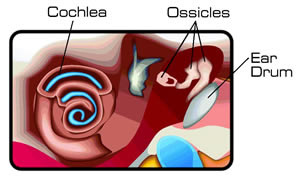
Creative design and organization is seen throughout the hearing process, starting with our eardrum that functions as a resonator. The faintest sound people can hear is due to the eardrum moving a mere one tenth the diameter of a hydrogen atom. The eardrum's movement is transmitted by three of the smallest bones in our body to specially designed lymphs (fluids) in the amazing cochlea. Vibrations from the ear bones (ossicles) are sent through the fluids which are then transmitted into nerve impulses in the true organ of hearing, the organ of Corti. The impulses proceed through the vestibulo-cochlear nerve to the brain for interpretation.
The evidence for a "clearly seen" (or in this case, heard) creation is forcefully found in the innermost workings of our ear. Research has revealed incredible features of the auditory and vestibular sensory systems. There are ultra-tiny, braided structures extending from a hair cell to an abutting taller sensory cell (sterocilia) called the tip link.1 All these cells are submerged in the above-mentioned lymph. Through detailed interactions of elastic elements and gating springs, the tip line (the braided portion of the tip link) opens ion channels in the taller stereocilium. This happens when the tip line is pulled as the cells move—like wheat stalks in the wind—in response to sound. Various ions are now allowed to rapidly enter the cell and contribute to membrane depolarization, part of the hearing process. "There is still considerable uncertainty about subsequent events"2 but this detailed process may also require a special molecular motor embedded in the stereocilium membrane. The tiny motor is connected to the tip line and it moves the entire ion channel down and up the cell membrane to close the channel. In previous ICR articles, these amazing molecular machines were discussed (Acts & Facts, April 2004) and "are still not fully understood."3
Whether it's hearing thundering ocean surf, Chopin's emotional nocturnes, or "Lunch is ready!" there are aspects of this process that remain a deep mystery. Detailed research that will one day possibly answer these questions will have no Darwinian foundation. "He who hath ears to hear, let him hear . . ." the case for creation!
- http://www.molbiolcell.org/content/vol12
/issue5/cover.shtml - Ganong, Review of Medical Physiology, McGraw Hill, 2003, p. 178.
- http://www.nanonet.go.jp/english/mailmag
/2005/061b.html