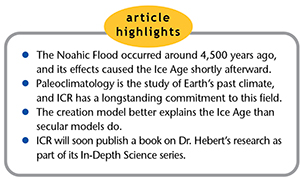
 Because the Genesis Flood caused the Ice Age,1 studies of Earth's past climate, or paleoclimatology, have long been a focus of the Institute for Creation Research’s research programs. One of my tasks is to build upon the Ice Age work of atmospheric scientist Dr. Larry Vardiman,2-4 who retired from ICR in 2012.5
Since 2016, ICR publications have revealed serious problems with an iconic argument for the secular Ice Age theory.6 In an earlier column, I discussed a new phase of research: studying the pre-Flood climate, particularly the possible absence of rain (Genesis 2:5-6).7 Rain requires clouds, and clouds require droplets of water. In order for cloud droplets to form, suitable “seeds” for droplet formation—called cloud condensation nuclei (CCNs)—must be present in sufficient numbers in the atmosphere. Yet, some sources of CCNs could reasonably be expected to be absent or greatly diminished in the pre-Flood world. These include dust particles from dust storms, volcanic aerosols, and significant quantities of man-made pollutants. Perhaps a dramatically lower number of pre-Flood CCNs might have inhibited rain in the pre-Fall and pre-Flood world. I still think this idea may have merit, but discussions with other creation researchers revealed that the issue is more complicated than I originally thought. For that reason, this particular project has been tabled for now.
Meanwhile, I am doing more research on the deep ice cores of Greenland and Antarctica. In 1994, Dr. Vardiman published a one-dimensional, young-earth model for the rapid formation of thick ice sheets, and I am building upon his work.8 I am particularly interested in estimating the true thicknesses of annual layers in the deep ice cores, using simple ice-flow computer models and an assumption of high post-Flood ice accumulation rates. I have already extended Dr. Vardiman’s work and submitted a paper for publication, and I hope to expand on his efforts even further.
In the creation model, annual layers in ice cores are much thicker on average than in secular models. Obtaining better estimates of annual-layer thicknesses may enable us to test predictions made by the creation and secular models. In some ways, the creation model already makes better sense of the ice sheet data.9
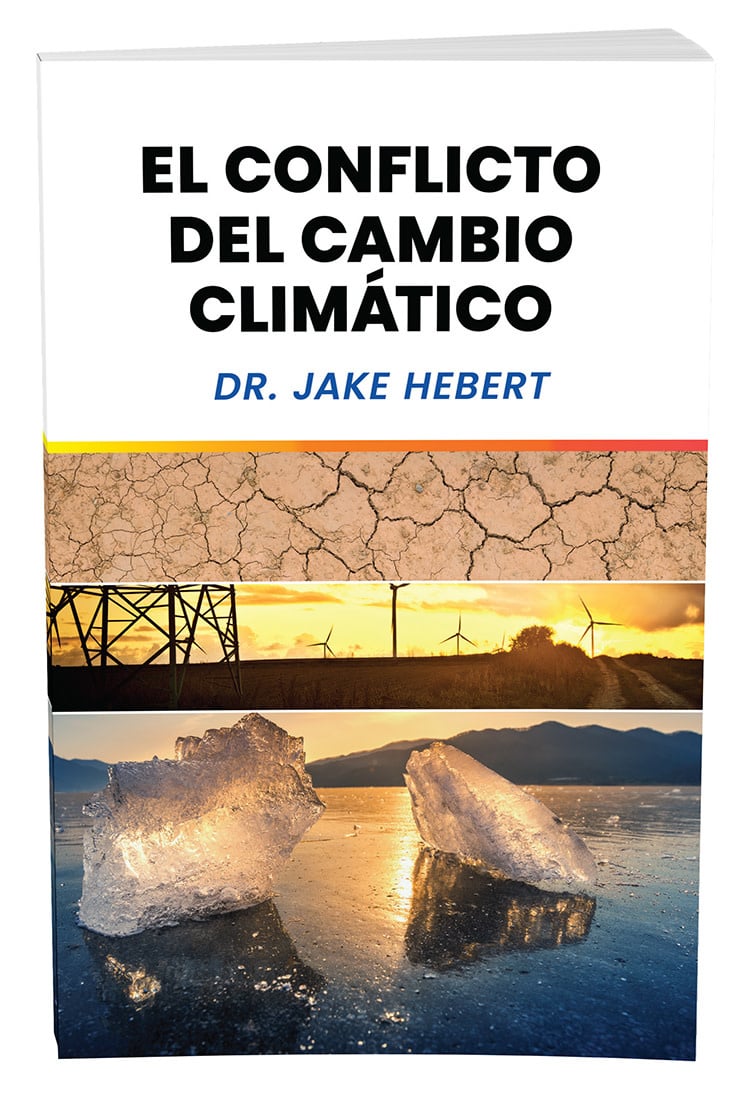
In the meantime, evidence for the biblical Ice Age model continues to accumulate,10 and ICR continues to produce resources addressing questions regarding climate change and the Bible.11 In fact, I’m currently working on a book dealing with climate change from a biblical perspective as part of ICR’s In-Depth Science series. The book will show that the Bible provides the best framework for understanding Earth’s history, including past climate change, and it will explain how one’s origin beliefs dramatically influence one’s views of global warming. I argue that climate alarmism is largely rooted in a denial of Genesis history.
As ICR celebrates 50 years of fruitful ministry, we remember that none of this would be possible without God’s faithful provision through you, our donors. Thank you for your generosity that has made this research possible.
References
- Hebert, J. 2018. The Bible Best Explains the Ice Age. Acts & Facts. 47 (11): 10-13.
- Vardiman, L. 2001. Climates Before and After the Genesis Flood: Numerical Models and Their Implications. El Cajon, CA: Institute for Creation Research.
- Vardiman, L. 2010. An Ice Age in Yosemite National Park. Acts & Facts. 39 (3): 12-13.
- Vardiman, L. 2013. Numerical Simulations of Winter Storms, Tropical Cyclones, and Nor’easters During the Ice Age Using the NCAR WRF Model with a Warm Ocean. In Proceedings of the Seventh International Conference on Creationism. Horstemeyer, M., ed. Pittsburgh, PA: Creation Science Fellowship.
- Ford, L. 2012. Dr. Larry Vardiman Retires from ICR. Acts & Facts. 41 (7): 22.
- Hebert, J. Physics Today Article Ignores Monster Milankovitch Problem. Creation Science Update. Posted on ICR.org May 24, 2020, accessed August 3, 2020.
- Hebert, J. 2018. ICR Climate Research Advances. Acts & Facts. 47 (8): 9.
- Vardiman, L. 1994. An Analytic Young-Earth Flow Model of Ice Sheet Formation During the “Ice Age.” In Proceedings of the Third International Conference on Creationism. Walsh, R., ed. Pittsburgh, PA: Creation Science Fellowship, 561-568.
- Hebert, J. 2019. Earth’s Thick Ice Sheets Are Young. Acts & Facts. 48 (2): 11-14.
- Hebert, J. 2020. Missing Ice Age Forests Fit Flood/Ice Age Model. Acts & Facts. 49 (6): 16-19.
- Hebert, J. 2019. The Climate Change Conflict: Keeping Cool Over Global Warming. Dallas, TX: Institute for Creation Research.
* Dr. Hebert is Research Associate at the Institute for Creation Research and earned his Ph.D. in physics from the University of Texas at Dallas.