



A CHALLENGE
One of the most profound and moving experiences in the life of the Old Testament patriarch Job must have been his encounter with a whirlwind. At a time when Job's undeserved suffering led him to a point of despair, God questioned Job from the whirlwind concerning his knowledge of Creation (see Job, Chapter 38). God confirmed his sovereignty and justice by giving what must rank as the greatest science test of all time.
Among the most thought provoking of God's questions to Job was, "Have you entered into the springs of the sea?" (Job 38:16a). The word for "springs" is NEBEK (transliterated from Hebrew), an unusual word referring to the places where water issues or bursts out of the earth. Job must have pondered this question with amazement, for although he had seen many springs on the land, he had no experience with undersea springs. Today we know why. The ocean is very deep; almost all the ocean floor is in total darkness; the pressure there is enormous. It would have been impossible for Job to have explored the "springs of the sea."
Other Old Testament passages refer to springs of the sea. Genesis 7:11 describes the cause of Noah's Flood and says that the "fountains of the great deep were broken up and the floodgates of heaven were opened." In the phrase "fountains of the great deep," the word "fountains" is MAYANOTH in the Hebrew and refers to "springs" or something similar in many other passages in the Old Testament. The phrase also mentions the "deep." The "deep" is the Hebrew TEHOM that is mentioned in Genesis 1:2, where God's Spirit brooded upon the face of the "waters," or the "deep."
Psalm 33:6-9 describes springs in the ocean relating them to their creation. The Psalmist says, "By the Word of the Lord were the heavens made, and by the breath of His mouth all their host. He gathers the waters of the sea together as a heap; He lays up the deeps in storehouses. Let all the earth fear the Lord, let all the habitants of the world stand in awe before Him; for He spoke and it was done, He commanded and it stood fast." So, from the beginning of the creation, this passage is saying that the waters of the sea were heaped together. In characteristic Hebrew style this is rephrased in Psalm 33:7b as, "He lays up the deeps in storehouses." So, there is some vessel which is containing a portion of the deeps from the original creation.
Proverbs 8 contains an interesting personification of wisdom, where Wisdom speaks. Beginning at verse 22 we read, "When there were no depths, I (Wisdom) was brought forth; when there were no springs abounding with water, before the mountains were settled, before the hills, I was brought forth." Then verse 28 of Proverbs 8 says, "When he made firm the skies above, and the springs of the deep became fixed." Here is another direct reference to springs being in the ocean.
There are four main points in this matter that the Old Testament affirms. First, the Old Testament asserts positively that springs do exist in the ocean. The source of this knowledge claims omniscience and is allowing that omniscience to be tested by scientific investigation of the ocean floor. Second, the undersea springs are said to have been established at the earth's creation. Third, the Flood of Noah is claimed to have been caused, at least in part, by an unusual activity of ocean floor springs. Finally, springs are mentioned so we can marvel at the wisdom and power of God.
THE DISCOVERY
The discovery of ocean floor springs represents a great milestone in the scientific investigation of the earth. Before 1930 little was known about the ocean floor. Volcanoes were observed to break the sea surface and this provided evidence of undersea volcanism. Because modern volcanoes on land emit steam, scientists suggested that water might be coming out of volcanoes on the ocean floor.
The deep sea dives of William Beebe's bathysphere in the 1930's provided a close look at the ocean floor, but no springs were observed. In the 1940's mapping of undersea topography was under way using the echo sounder. Thousands of undersea volcanoes called "seamounts" and "guyots" were recognized and speculation about undersea springs increased. In the 1960's metal-rich, hot brines were discovered using sonar in the bottom of the Red Sea. This brine was an indirect evidence of water coming out of the ocean floor. Aided by reports from Mexican abalone divers, scientists using scuba equipment located shallow-water hot springs along the coast of Baja California in the late 1960s.
 |
|
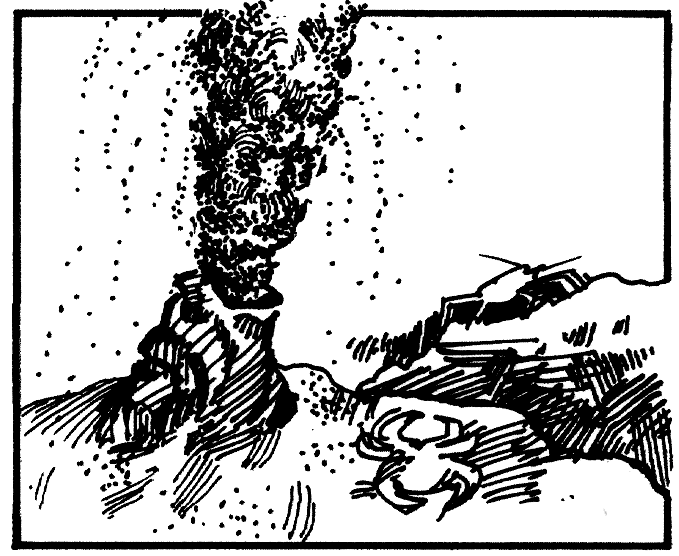
Vent in the seafloor where hot water issues from the earth into the ocean. |
Deep diving research submarines have been constructed to withstand the three-tons-per-square-inch pressure at the ocean floor. These submarines have carried scientists into the deep. The first direct observations of deepsea springs, or their mineralized vents, appear to have been made on the Mid-Atlantic Ridge by Project FAMOUS in 1973. Spectacular hot springs were then discovered on the Galapagos Rift in the Pacific Ocean by the 23-foot long submersible Alvin in 1977. Alvin also explored, photographed and sampled hot springs on the East Pacific Rise just south of the Gulf of California in 1979. The research continues.
Several nontechnical magazine reports present photographs and descriptions of these recently discovered seafloor springs. The Galapagos Rift springs are described in the November 1979 issue of National Geographic. The article is titled "Incredible World of the Deep-sea Rifts" and bears the caption: "Scientists explore rifts in the seafloor where hot springs spew minerals and startling life exists in a strange world without sun.
The East Pacific Rise springs are shown in Science News, January 12, 1980. This article is titled, "Smokers, Red Worms, and Deep Sea Plumbing" and is followed by the caption; "Sea floor oases of mineral-rich springs and amazing creatures fulfill oceanographers' dreams." The discovery of these deep ocean springs is said to be the "most significant oceanographic find since the discovery of the Mid-Atlantic Ridge."
The hot springs have been called "black smokers." The "smoke" is the dark, mineral-laden, hot (up to 400'C) water spewing from "chimneys" up to 15-feet tall atop mounds of minerals up to 60-feet high. The minerals coating the vents are largely sulfides of copper, iron and zinc precipitated instantly as the hot geysers contact the cold seawater. The vents provide the habitat for the first community of animals to be discovered which does not obtain energy by way of photosynthesis. Animals collected include red-tipped tube worms, giant clams, mussels, sea worms, crabs, and limpets. The Science News article describes the East Pacific Rise springs: … the researchers found about two dozen hot springs stretched along 6 km of the half-kilometer wide spreading center. But next to these angry-looking, superheated geysers—called "smokers"—the Galapagos Rift vents looked like tepid sprinklers. Not only was the gushing water about 300'C hotter (the first attempt to measure the water temperature melted Alvin's heat probe), but around the chimneys lay mounds of minerals including copper, iron, zinc and sulfur with lesser amounts of cobalt, lead, silver and cadmium. Like the Galapagos, however, the same animals, with the exception of the mussels, were clustered in fields near the vents.
Although scientists have examined only a small portion of ocean floor, seafloor springs appear to be common along the 40,000-mile Mid-Oceanic Ridge system. Dr. John M. Edmond of M.I.T. suggests that water circulation through oceanic springs is a major geologic process; he estimates that 40 cubic miles of water flow out of earth's oceanic springs each year. If this is so, then mineralization must be an important process on the sea floor, and study of ocean springs may promote understanding and location of ore deposits. Ocean springs are also a vast, untapped source of geothermal energy, which, unfortunately, is located far from the major population and energy demand areas.
The discovery of ocean springs ranks as one of the foremost scientific accomplishments of the last ten years. Let us remember, however, that their existence was known thousands of years ago. Surely, God spoke through men by means of His Holy Spirit.
Short BIBLIOGRAPHY On Springs of The Ocean
Ballard, Robert D., and Grassle, J. Frederick, "Incredible World of Deep-sea Rifts," National Geographic, V. 156, No. 5, November 1979, pp. 680-705.
West, Susan, "Smokers, Red Worms, and Deep Sea Plumbing," Science News, V. 117, No. 2, January 12, 1980, pp. 28-30.
Corliss, John B., et a]., "Submarine Thermal Springs on the Galapagos Rift," Science, V. 203, No. 4385, March 16, 1979, pp. 1073-1083.
* At time of publication, Dr. Austin was a Research Associate in Geology and head of the Department of Geology at ICR.
Cite this article: Austin, S. 1981. Springs of the Ocean. Acts & Facts. 10 (8).