Introduction
There is nothing more devastating to the doctrine of evolution than the scientific evidence of a young earth age. That evidence is provided by the rapid depletion of the energy in the earth's main magnet, its electromagnetic dipole magnet in the conductive core of the earth. Its electric current is using up the magnet's energy. The rate of energy consumption is now known. From that information and a reasonable limit on the maximum plausible initial energy one can show that the earth's magnetic age is limited to thousands of years, not the billions claimed by evolutionary scientists.
A search of the technical literature in 1970 provided two important clues to this explanation of the earth's dipole magnet:
- In 1883 Sir Horace Lamb solved the complex electromagnetic problem of a free current circulating in a conducting sphere.1
- Evaluations have been made on the strength and direction of this dipole magnet in the core of the earth ever since the first historic evaluation was made by Gauss in the 1835 epoch. 2,3 The first clue predicted decay, the second clue confirmed it. Rarely in physics has there been a better illustration of a mathematical physics theory and such extensive observational data to confirm it.
The author's articles and book, that developed and applied this theory of a freely decaying magnet to an earth-age limitation, were ignored by doctrinaire evolutionists for years. They apparently felt that the less said the better. In 1981, however, the American Civil Liberties Union decided to make an all-out attack upon it. The U.S. Geological Survey research geologist G. Brent Dalrymple has spearheaded the attack. In addition to his appearing as their expert witness in the courts, he has written a book and an article in the Journal of Geophysical Education4 attacking this author's publications on the theory of the earth's magnetic age limitation. This Impact article is a response to his geological education article.
Dalrymple's Dynamo Hypothesis
As is true of most evolutionary geologists, Dalrymple hypothesizes a dynamo in the molten core of the earth. It is supposed to be the mechanism for generating the electric current required to power the dipole magnet for more than three billion years. Dalrymple states: "Barnes criticizes the dynamo theory because of the absence of a definitive solution. " He then goes into a lengthy discourse about dynamos. One may summarize his ultimate conclusion by his own statement: "Even though there is near universal agreement that a dynamo exists in the earth's core, the exact mechanism …is not known."
Not only are evolutionists in trouble by having nothing but faith to support their dynamo hypothesis, the same can be said for their lack of an applicable energy source to run the dynamo. One has but to review the literature to see that no one has come up with an acceptable energy source. Dalrymple uses the "scatter-gun" approach. "At present, scientists do not know which of the several sources actually drives the dynamo; in fact, it may be some combination of sources." Prior to that he stated: "At present it seems that gravitation may be the most plausible source of energy.... " That is nonsense and completely unsupported. There is as yet no concept as to how that type of energy would be able to run the mechanism, if there were such a thing.
Signal vs. Noise
The basic problem with the evolutionary geologists' education on the earth's magnetism may be expressed in the language of an engineer as his failure to distinguish between the signal and the noise. The two are not functionally related. The earth's dipole field is the signal. It is known to be due to electric current in the core of the earth, more than a thousand miles away from the earth's surface. The noise is the super-position of all other magnetic fields from whatever magnetic sources that may exist near enough to make any contribution to the net magnetic field at any point where the measurements are being made. There are literally billions of sources of magnetic noise and ordinarily their location and energy content are not known. For example, there are times when there are magnetic storms of such magnitude that transatlantic radio communication is totally disrupted.
As an illustration of Dalrymple's failure to make this distinction between signal and noise one should examine his statement: "Barnes' hypothesis also does not fit the facts. Freely decaying currents cannot explain the existence, configuration, movement, or changes of the nondipole field...." Dalrymple does not seem to understand that the nondipole field is noise, not the signal. The magnetic age of the earth is related to the signal, the dipole field, not to the noise. The dipole field is decaying in accordance with known theoretical physics equations. That is the signal which Gauss separated from noise when he made his historic evaluation.
Dalrymple quotes the following statement from Barnes: "As of now there is no physical evidence, seismic or otherwise, that there is any motion within the core." He rejects that and cites a westward motion of the nondipole field as evidence of motion in the core. His point is to justify the evolutionary claims of fluid motion in the core as the dynamo mechanism. That is irrelevant because as previously noted, there is no known dynamo mechanism. Nevertheless, it shows his failure to distinguish between signal and noise. The nondipole field is noise and no one knows the location of its source. Without knowing the location of the sources of the noise one cannot compute its total energy.
There has been a measured westward drift of the earth's magnetic dipole, a precession but not a nutation. Stanley Stanulonis has derived a theoretical physics explanation of this westward precession.5 It is due to the solar wind drag on the magnetic dipole field as the earth rotates eastward. The net result is a shifting of the electrical currents in the core of the earth, not a motion of the molten mass in the core of the earth. Stanulonis' solution contains both the precession and decaying properties of the earth's magnetic dipole field. Those are properties of the signal, not the noise.
Dalrymple holds to the evolutionary arguments that paleomagnetic evidences show that the earth's magnetic field is more than three billion years old and has gone through many reversals, changing its polarity from north to south and back many times, at irregular intervals. Those and the other arguments of Dalrymple are answered in detail in the new revised and expanded edition of Barnes' Origin and Destiny of the Earth's Magnetic Field, Technical Monograph No. 4, published by the Institute for Creation Research (132 pp.).
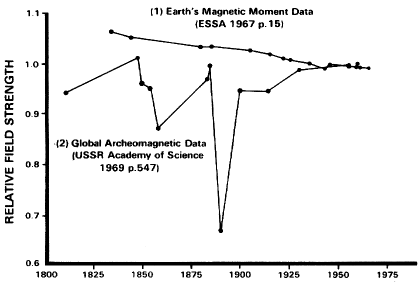
One cannot make a credible evaluation of the earth's magnetic dipole moment from such paleomagnetic data. They are useful for geophysical exploration, where anomalies indicate deviations from the dipole field, but not for evaluating the dipole field. That is illustrated by the graph shown. It compares the paleomagnetic data with the unquestioned real-time magnetic dipole moment data. The top curve is from the earth's magnetic moment data. It shows the known decay. The bottom jagged curve is derived from a Russian scientist's paper (S.P. Burlatskaya, 1967), which used all of the paleomagnetic data. Note that there is not the slightest trace of the known decay in the curve of these paleomagnetic data. One can classify the paleomagnetic data as noise and the real-time data as the signal.
Conclusion
The Barnes' theory of a young magnetic age for the earth, only a few thousand years, is the only theory of the source of the earth's dipole magnet that is supported by the following important facts:
- A rigorous mathematical physics solution.
- A history of real-time evaluations of the state of the magnet (its magnetic moment).
- A clearly identified source of energy (its own magnetic field energy).
- A definitive predictive value.
- A means of computing its source energy and subjecting that value to an independent check that would have falsified the theory had there not been a check.
On the other hand, the presumed dynamo theory has no substantive theoretical basis and no definitive predictive value. Its presumed reversal mechanism has admittedly remained inscrutable. The presumed supporting paleomagnetic data contributes to the noise, not the signal. It does not even check with the decay of the earth's dipole field during the time in which that is accurately known, ever since Gauss' evaluations.
The game is up for the evolutionist if he acknowledges that the earth is only a few thousand years old. To avoid being completely wiped out he knows that he must fight with all his might, fair or foul, against this scientific theory and supporting evidence of a young magnetic earth-age. It is no wonder that Dalrymple, his ACLU sponsor, and the nine additional noted evolutionists whom he acknowledges gave him review support on his article, have made such a desperate effort to conceal this Achilles heel of evolution, the scientific evidence of a very young earth.
 |
References
1. Sir Horace Lamb, Philosophical Transactions, (London) 174, pp. 519-549.
2. Sidney Chapman, The Earth's Magnetism. Methuen and Co., Ltd., London; John Wiley and Sons, Inc., New York, p. 23.
3. Keith L. McDonald and Robert H. Gunst. "An analysis of the earth's magnetic field from 1835 to 1965," ESSA Technical Report. IER 46-IES 1. U.S. Government Printing Office, Washington, D.C., p. 15.
4. Brent G. Dalrymple, "Can the earth be dated from decay of its magnetic field?", Journal of Geological Education, Vol. 31, No. 2, March 1983, pp. 124-132.
5. Stanley Stanulonis, "The Mechanism Responsible for the Precession of the Geomagnetic Dipole with Evaluation of the Earth's Core's Charge Density and Its Implication," Master of Science Thesis, University of Texas at El Paso, Physics Department, May 1974.